Dread going to work: the locator test most people skip
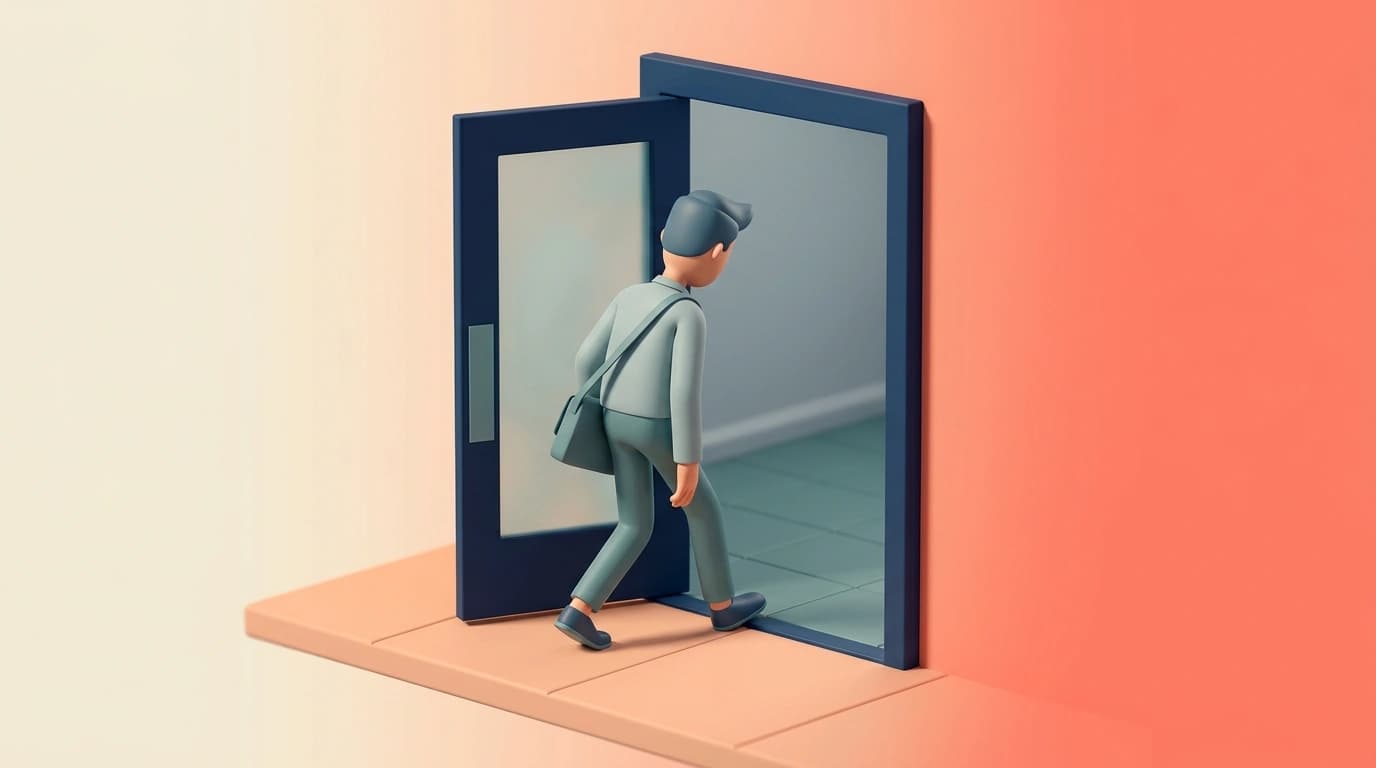
The parking lot test
Maya sits in her car in the office parking lot. It's a Tuesday morning. She's been there for nine minutes already. Her hands are on the wheel. The engine is off. She knows she's going to walk in, because she always walks in. She also knows that something in her body does not want to.
If you've been there, you already know the feeling. The interesting thing is where the dread attaches.
I'll admit I used to talk about this the wrong way, as if "the job" was the unit of feeling. Most people do. The phrase "I dread going to work" sounds like a verdict on the whole thing. In practice the scope is usually narrower than the whole job: a specific door, a recurring meeting that drains, one person on the team, the first ninety minutes of the day, the calendar shape of certain weekdays, or the morning ritual itself.
Skip the locator step and the dread keeps moving. You quit the job, take a new one, and a year later you dread going to work in a different parking lot. What you moved was the surface; the attach-point came with you. Locating the attach-point is the work. It's also the part most people skip.
Where the dread actually attaches
Asking "why do I feel dread about going to work" is the right first question. The better second question is: where, exactly, does the dread attach? Once you stop treating it as a generic complaint, six attach-points cover almost every case. Some people are in two at once. Most are in one, mainly.
1. A specific recurring meeting. Often a weekly status, a 1:1 with a particular manager, or a cross-team sync that runs hot. Tell: the dread spikes the night before and drops on weeks the meeting is cancelled.
2. One person on the team. A peer, a skip-level, a stakeholder, occasionally the direct manager. Tell: the same room without that person feels normal.
3. The commute. The drive, the train, the parking lot itself. Tell: working from home doesn't fix the bigger picture, but it lifts the morning weight more than seems proportionate to one missing drive.
4. The first ninety minutes of the work day. The way the morning opens: back-to-back meetings, a notification flood, an inbox you can't catch up on. Tell: afternoons feel okay. The dread is morning-shaped.
5. The calendar shape of certain weekdays. Monday dread lives here. So does the "Tuesdays are hell" pattern. The day itself rarely is the load-bearing thing; whatever lives on that day's standing calendar carries the weight.
6. The morning ritual itself. The alarm, getting dressed for the role, becoming the work version of yourself. This one is harder to name from inside, because it shows up as a kind of pre-work heaviness that the actual workday eventually softens.
Maya re-runs her own week in her head. The dread is Tuesday-shaped. She has a standing 9 a.m. with one specific manager on Tuesdays. The dread is attached to that.
This is the locator. If you can name your attach-point in one sentence ("the Tuesday 9 with Mark" instead of "my job"), most of the rest gets easier. If yours doesn't narrow down to a specific surface, the wider read on the five-archetype diagnostic is in our main piece on job-hate.
Normal-vs-signal
Some dread is normal. The question is when it isn't.
A useful test is recoverability. Does a real two days off (phone away, not catching up on email) refill you for Monday? If yes, your dread is task-attached and the locator above does most of the work. If a weekend doesn't refill you, scale up: does a one-week vacation refill you? If yes, the dread is heavier but still tractable. If even a one-week vacation doesn't refill you, and the dread re-arrives on the Sunday evening of vacation week, you're outside the locator question. You're in something closer to system-wide burnout, and a different read applies; start with our piece on whether the right frame is hate or burnout.
The most common paradox in this territory sounds like a contradiction: "I dread going to work when I like my job." It looks self-cancelling, but usually isn't. What's happening is that an otherwise-okay job has accumulated one or two surfaces (a meeting, a person, the commute) that have started carrying the whole dread weight. The "I like the job" read is true on the wider shape. The dread is true on the specific surfaces. They're pointing at different scales. Naming the surface is what unsticks the contradiction. Christina Maslach's burnout work points at the same shape from another angle: dread that survives the recoverability test usually has an exhaustion-and-cynicism axis under it, and the "wrong job" frame tends to mislabel that.
Frequency matters, but less than people think. A single rough week reading as dread is almost always a passing mood. Daily dread that persists for more than a month and survives at least one full weekend is the version worth doing the locator work on.
What to fix first once you've located it
Order matters. Smallest reversible move first. Quit-the-job is the largest move, and it comes last.
Maya's Tuesday locator gives her something to work with. The cheapest move: shift the standing 9 a.m. with Mark to 2 p.m. on Thursday. Different day, different time of day, no surrounding chain of stacked meetings around it. She keeps the job. She keeps Mark as her manager. The only change is when she has to be a particular version of herself with him.
A short menu of small reversible fixes, keyed to attach-point:
- Recurring meeting: move it, shorten it, or kill it. Many recurring meetings survive on inertia rather than need; ask the owner.
- One person on the team: request a changed working arrangement (a new cadence, a new forum, or a stakeholder ladder where a manager mediates). Less drama than people fear.
- Commute: one day a week working from home, fewer than you'd guess, often does the trick.
- First ninety minutes: block the calendar 8:30 to 10. No meetings before ten. Almost always defensible if you ship.
- Weekday shape: redistribute standing meetings off the bad day.
- Morning ritual: put a twelve-minute pre-work ritual between the door and the desk — a walk, a coffee somewhere outside the kitchen, a book chapter on the bus. Something that becomes a real transition. Sounds small. Tends to land bigger than expected.
Two to four weeks is the test window. If the small fix lands, you have your answer. If it doesn't, escalate to the next-smallest. The runway and vesting math for any larger move is the same conversation it ever was, covered in our golden handcuffs piece. It belongs later in the sequence.
When the dread is the right answer
Sometimes the locator narrows the dread to a single attach-point, and the small fixes have all been tried, and the dread stays. The Tuesday gets moved to Thursday, and the Thursday becomes the dread. The meeting moves under a new manager, and the dread follows. The remote day arrives, and the parking lot in your kitchen still has the parking lot feeling.
At that point the dread carries real information. It's your body's clearest read on a structural problem, and the right move is to listen.
That's where the larger conversation starts. Runway. Vesting. The next role. The five-archetype read.
Some months later, Maya is on a different team. Same company. The Tuesday 9 a.m. with Mark doesn't exist anymore; she has a different manager, the standing got moved off her calendar entirely, mornings now open with quiet work instead of meetings. One morning she walks across the lot toward the same door she used to dread. She notices, partway across, that her body didn't tense.
References
- World Health Organization. "Burn-out an 'occupational phenomenon': International Classification of Diseases." 28 May 2019. The ICD-11 entry (code QD85) classifies burnout as an occupational syndrome and is the source behind the recoverability-test framing in this article's normal-vs-signal section.