How to choose your misogi: the three filters and the tiebreaker
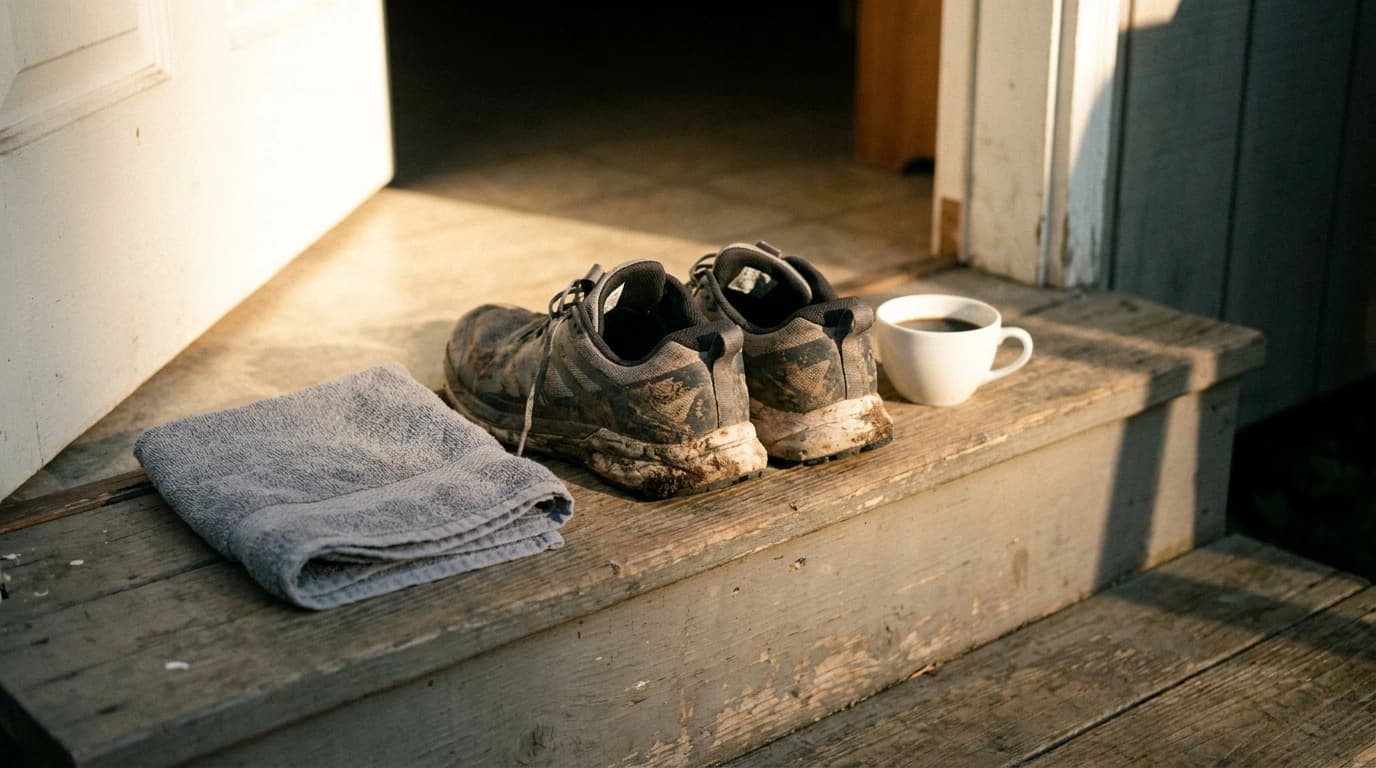
Marcus Elliott runs a sports-science lab in Santa Barbara called P3. He has told the same story across podcast interviews and in an Outside profile by Brad Stulberg. In the summer of 2014, he and a small crew — including the NBA shooter Kyle Korver — dropped into the water off Santa Cruz Island carrying stones, one 85 pounds and one 68 pounds. The plan was a five-kilometre relay along the ocean floor, in a stretch of Pacific that had recently seen shark attacks: dive down, find the rock, walk with it underwater as long as you could, drop it, signal the next person. He talks less about the finish, which took roughly five hours, than about what was going through his head somewhere around hour three. The stones were heavier in the water than they had been in training, the visibility was worse, his partners were tiring faster than the plan had assumed, and the version of the day he had picked the previous winter no longer existed. He kept going. The day he was doing now had very little to do with the day he had chosen.
The misogi you would happily commit to is probably the wrong one. Most people pick the version they could already describe at dinner. The version that would actually change them is the one they flinch from saying out loud, and choosing well is mostly about being honest about which one that is. If you are new to the practice, our main piece on misogi covers the Shinto origin, Itzler's three rules, and why people do it once a year.
Skip to:
- The three filters: friend-bet, audience, cost
- The tiebreaker when two ideas qualify: the reluctance signal
- The four pre-attempt mechanics: kit, route, fuel, stop
- The 48-hour read after: what to listen for
- The misogi you would not have chosen a year ago
The three filters
Itzler's rules tell you what a misogi has to be. These three filters tell you whether your idea actually meets them.
Filter one. Would a friend who knows you bet against your finishing? Not a stranger, but a specific person who has watched you train and watched you quit things. Describe the idea to them in one paragraph, then watch their face. If they say yeah, you will be fine, it is a project. If they say I genuinely do not know, you are in the 50 percent band. Use this as a real test, not a thought experiment.
Filter two. Can you keep this off your audience for the whole arc? That means Strava, Instagram, the podcast, LinkedIn, the Slack channel where you announce you are training for something. From the day you commit through the day after the attempt, the idea stays inside a small circle — the people training with you, your spouse, a coach if you have one. The moment an audience shows up, the misogi turns into a content event, and you start choosing the version that will look good in photos. If you cannot resist posting about it, swap it.
Filter three. Does the cost match a once-a-year event? A real misogi costs something concrete: training time across months, a weekend or a week away from your family, kit you actually buy, and the risk of an injury that takes weeks to walk off. If the cost is trivial, your body does not treat the event as different from a normal week, which is the point Andy Walshe's high-performance work at Red Bull repeatedly returns to. If the cost is enormous, on the order of your marriage or your job, you have crossed into a different category.
A candidate that fails any one of these is not a misogi. Most online misogi posts fail filter two by definition.
The tiebreaker when two ideas qualify
Two candidates clear all three filters. Now what.
Pick the one you would be more reluctant to describe out loud to the friend from filter one.
The reluctance is the signal. A candidate you describe easily is one you have already rehearsed in your head, in the version where you finish: you can see yourself at the end, and you already know what you would tell people. The candidate you stumble over still carries real uncertainty, because you have not been able to picture it landing yet. That leftover uncertainty is what does the work on you.
The candidate you most want to talk yourself out of is usually the right one — the reluctance is what tells you the uncertainty is real. The closer Japanese phrase is kowai keredo yaru (怖いけれどやる), "frightening, but do it anyway." Reluctance is data.
One caution. Reluctance can also mean something is genuinely dangerous: technical climbing without training, open-water swims without safety personnel, altitude without acclimatization. That signal means get the right support or pick something else. Itzler's second rule, you can't die, is not a joke, and the tiebreaker only applies when both candidates meet the safety floor.
The four pre-attempt mechanics
The point of preparing well is that on the day, the misogi is the misogi and not the logistics. Four mechanics are the floor.
Kit. Every piece of gear that touches your body (shoes, pack, fuel bottles, layers, headlamp) has been used during training under similar load. New shoes are the most common preventable misogi failure in the writeups I have read privately. Do not buy anything in the final week.
Route. You have walked, driven, or studied the actual ground at least once with the gear you will carry, on the real terrain rather than from a map. For non-geographic misogis like a musical performance, a language exam, or a retreat, the equivalent is a full dress rehearsal. Do it in conditions as close to the day as you can get.
Fueling and pacing baseline. A written plan: calories per hour, water per hour, electrolytes, and the pace you will hold past the point where your body asks to go faster. For non-endurance misogis, the equivalent is your sleep, your eating, and your daily structure across the week. The plan exists so you do not have to make food and pacing decisions on the day, when your brain is already loaded.
Emergency-stop trigger. Before the day, you and at least one other person agree on the specific conditions under which you stop: a core temperature above or below a threshold, a heart rate that will not come down after twenty minutes, a medical symptom, a weather event. The trigger is written, the second person can call it, and you have agreed in advance that the call is honored. The 50 percent rule applies to whether you finish. It does not apply to whether you make it home.
A misogi carries real uncertainty about completion. A stunt carries real uncertainty about survival.
The 48-hour read after
The hardest part of the practice is reading the days after the attempt, not the attempt itself. Three signals tell you the choice was right.
The memory is larger than the event. When you describe the day to your spouse forty-eight hours later, it feels bigger in your head than it looks on the results sheet. Twenty hours feels like more than twenty hours; a thirty-minute performance feels like more than thirty minutes. Maslow's Religions, Values, and Peak-Experiences (1964) made the same point about rare events sitting larger in memory than they did on a clock.
Ordinary friction feels smaller. The Monday email that would have spiked your heart rate two weeks ago lands as a Monday email. What you get is a quiet drop in what registers as hard. It is well short of euphoria. If your floor has not moved at all by the end of week one, the candidate was probably too easy.
You are reluctant to talk about it. The no-talking rule does not stop at the finish line. Forty-eight hours after a real one, the instinct is usually privacy: you answer the friend who asks, but you do not bring it up at the dinner. It is the same kowai-keredo-yaru shape. The event was large enough that talking about it shrinks it.
If two of those three signals are missing, the calibration was off. Most people I know who have done this say the choosing gets noticeably better around the third cycle, once they have learned to read their own reluctance honestly. The skill being built is partly the choosing itself.
The misogi you would not have chosen a year ago
The strongest sign that you are choosing well is that this year's candidate is one you would not have chosen, and could not have chosen, a year ago. The 2025 candidate that scared you then has been outgrown. The 2026 candidate carries the same flinch in a new shape.
Elliott has circled this in interviews without quite naming it. The man who picked the route the previous winter and the man crossing the seafloor at hour three are not really the same person, and the misogi pulls them apart. The November version of you picks what the November version can stand; the April version, after, can stand more. So the next November is where the real test shows up: can you again pick something the new floor flinches from, or have you started picking what last year's floor would have been comfortable with?
Most people pick the same misogi twice. That is the failure mode the whole practice exists to prevent.
References
- Easter, M. (2021). The Comfort Crisis: Embrace Discomfort to Reclaim Your Wild, Happy, Healthy Self. Rodale Books.
- Elliott, M. Outside: Brad Stulberg, "The One-Day-a-Year Fitness Plan." outsideonline.com. Includes the documented 2014 Santa Cruz Island underwater rock relay with Kyle Korver and the 2013 Channel Islands paddleboard. Sports Illustrated: "Atlanta Hawks' Kyle Korver trains by running in shark-infested water while carrying giant rocks." si.com. ESPN: "Kyle Korver's Everest." espn.com.
- Itzler, J. Books (including Living with a SEAL) and guest appearances on podcasts including My First Million, Rich Roll, BiggerPockets, and others; misogi discussed across multiple appearances.
- Maslow, A. (1964). Religions, Values, and Peak-Experiences. Ohio State University Press.
- Walshe, A. Red Bull High Performance program (2014-2020); Project Acheron; interviews on peak ordeal events.