Sitting in silence: a five-minute protocol and what shows up
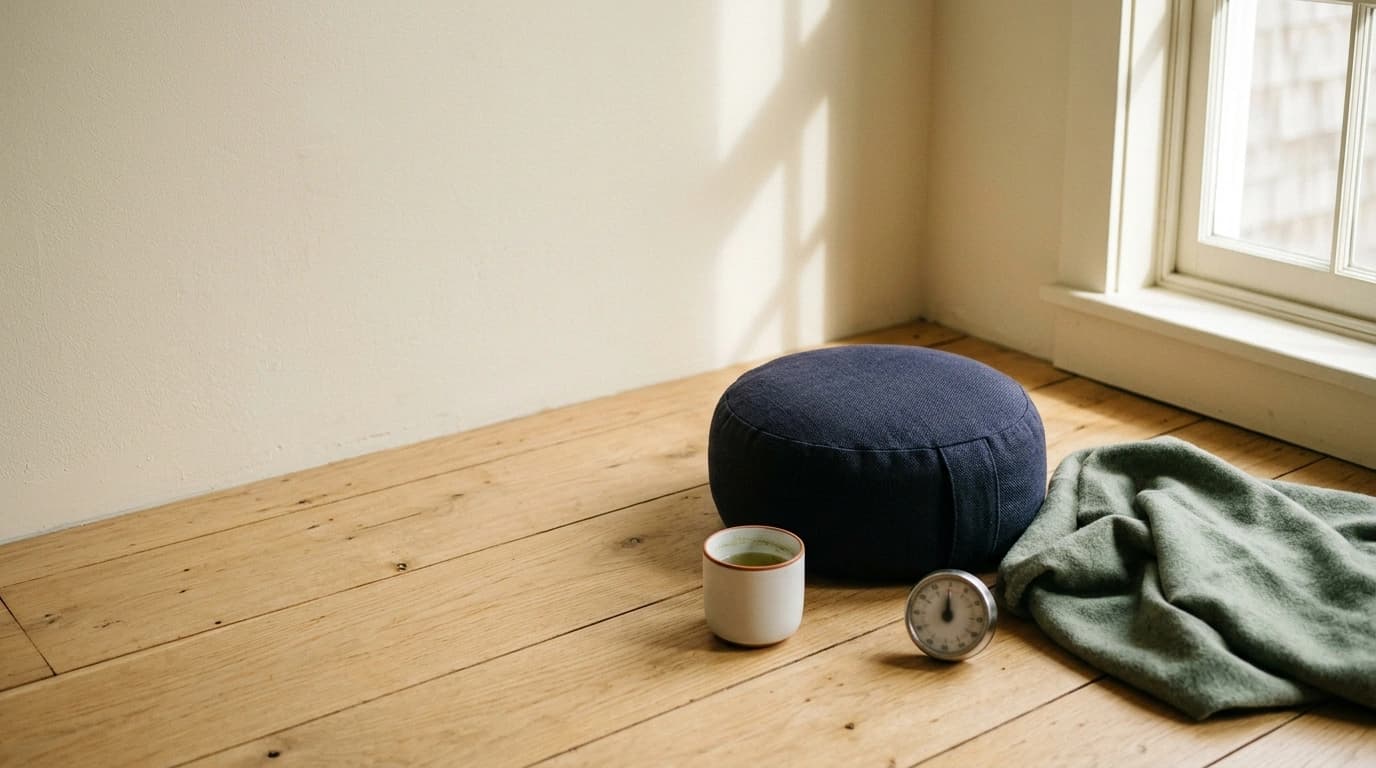
Five minutes of silence sounds louder than five minutes of music to anyone who has not tried it recently. The ambient noise, once the external sound is removed, turns out to live inside the head. A to-do list rehearses itself. An unanswered email replays. A conversation from Tuesday revises itself for the twelfth time. The term for this background activity is the default mode network, a set of midline brain regions that activate when attention is not directed outward (see default mode network for the neuroscience).
Why five minutes of silence sounds louder than five minutes of music
Pascal wrote in his Pensées that all the unhappiness of men comes from one single fact: "that they cannot stay quietly in their own chamber." He meant something closer to a diagnosis than a scold. When there is nothing to attend to, attention attends to its own content. For many people this is uncomfortable enough to be worth avoiding for a lifetime.
A popular sitting-in-silence meme captures the gap between expectation and experience: a serene image of a person seated by a window, captioned with the chaos of their actual thoughts. It works because almost everyone recognises it.
So, is sitting in silence good for you? The honest answer is that almost no one has studied five quiet minutes on a kitchen chair directly, and this article is not medical advice. The large research literature on meditation is about related but more structured practices. The benefits of sitting in silence that people describe are modest and build over weeks: a bit more space between an event and a reaction.
The kitchen-chair start: a five-minute protocol anyone can run tomorrow
The simplest way to practice silence is to sit on a kitchen chair, feet flat, phone face-down in another room, for five minutes. A timer helps. The eyes can be closed or softly focused on a point on the floor. The instruction is plain: do nothing. When a thought appears, notice it. When attention wanders, bring it back to the breath or to the sound of the room.
That is the whole protocol. Most beginners spend the first couple of weeks discovering that the mind cannot be emptied by trying. The mind quiets, if it quiets at all, as a side effect of ceasing the effort to run it. Versions of it appear in Zen, in Christian contemplative traditions, and in Vipassana.
Three practical notes on sitting in the silence:
- A chair works better than a cushion for most Western beginners. Posture rules in some meditation traditions assume a lifetime of floor-sitting that most Western adults do not have.
- Five minutes is enough to start. A long first sitting is easy to dread, and a dreaded practice rarely lasts the week.
- Daily beats long. Five minutes every day for a month builds more of a habit than one forty-minute sitting on a Sunday afternoon.
The walking version: silent walks when sitting feels impossible
For people who find sitting unbearable, a silent walk is a working alternative. The constraint is simple: no phone, no earbuds, no company. A twenty-minute walk through a park or a quiet residential street provides enough external input to anchor attention while leaving most of the mental bandwidth free for whatever surfaces.
The practice has an older name in some traditions. Walking meditation is a form practiced in Zen and Theravada Buddhist monasteries, where the pace is slow and the attention is on the body in motion. The Japanese practice of shinrin-yoku, forest bathing, overlaps with the walking version, with the added element of being under trees.
Silent walks solve a specific problem. The sitter who struggles to sit often blames the inability to sit, which starts a shame loop that ends the practice entirely. The walker gets the same thing: ambient mental noise becoming audible, then slowly settling, with the body in motion rather than at war with the chair.
The pause between sentences: being comfortable with silence in conversation
Being comfortable with silence in conversation is a separate practice that borrows from the sitting version. The social meaning of silence varies across cultures. In everyday English conversation, a pause of a few seconds can already feel awkward, and whoever is more anxious usually fills it. In Japanese meetings, longer pauses are more common and are often read as careful thought rather than awkwardness.
The practical move is small. In a conversation that has reached a point requiring thought, let the pause stand for one or two breaths before filling it. The other person often fills the gap with something more considered than their first draft would have been. The silence works as a kind of invitation.
Sitting in silence quotes circulate widely online: the Pascal line, Thoreau's chapter on solitude in Walden, Marcus Aurelius on retreating into your own mind. Most come from writers who treated solitude as a working condition. The common ground across the quotes is that the quiet is where the useful material gets found.
What the thoughts that show up are actually for
The hardest part of the practice is the material that surfaces. A forgotten argument, an old regret, an unresolved resentment, the second-guess about a career move three years old, a specific grief that resurfaces during a quiet hour.
This is the practice working as designed. The thoughts were present already, running in the background, driving small decisions and large reactions. Silence makes them audible. They are the material of a life being examined at its own pace.
Zen teachers call the right attitude shoshin, beginner's mind: meeting whatever comes up with openness rather than a verdict. Psychologists have a name for a similar move, cognitive defusion: noticing a thought as a thought instead of treating it as a fact. It is one of the core techniques of Acceptance and Commitment Therapy, which Steven Hayes developed in the 1980s. The two frames point at the same move. The thoughts carry information. The sitter is free to notice, breathe once, and come back.
Three to six weeks of five-minute daily sittings is a reasonable test. The change, if it comes, is unglamorous: a smaller gap between stimulus and reaction, a bit more room before saying the thing. The art of silence works as a slow shift in the ambient conditions of a life.
References
- Default mode network — Wikipedia article on the midline brain regions active during undirected attention.
- Pascal's Pensées — full text on Project Gutenberg, including the "stay quietly in their own chamber" passage.
- Acceptance and Commitment Therapy — Wikipedia article on the therapy and its cognitive-defusion technique.
- Walking meditation — Wikipedia article on walking-meditation practices across Buddhist traditions.