Caregiver burnout signs: four variables regular research misses
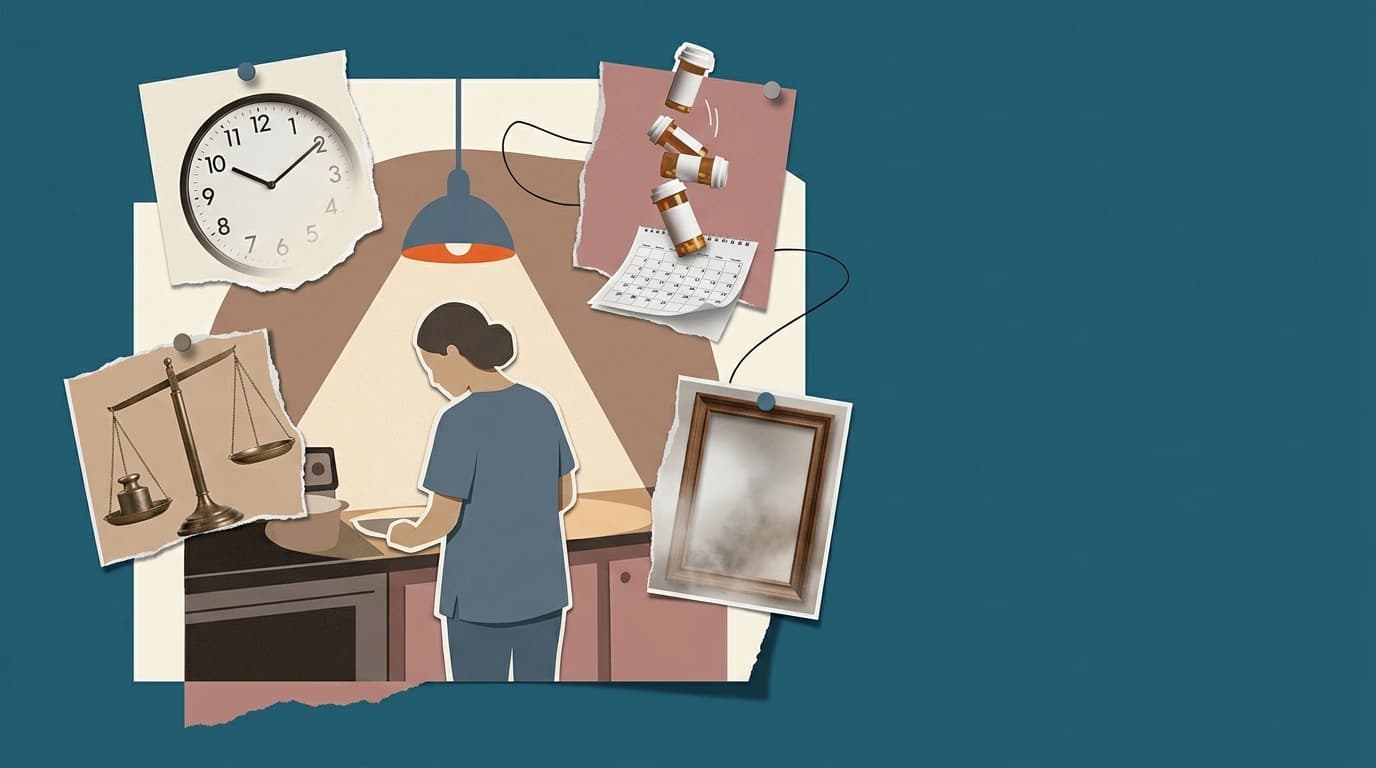
David is at the kitchen table a little after eleven, re-sorting his father's pill organizer for the third time this week. The pills are already correct. He sorted them Sunday morning. He sorted them again Tuesday because the carbidopa-levodopa package said something he hadn't read before. Now, Thursday, he's doing it again, and he can't say why.
He is tired. He knows he is tired. He hasn't slept more than six hours in a stretch since January. He thinks the tiredness is the whole story.
I'll admit I used to think the same thing about my own burnout. The exhaustion arrives first and arrives loudest, and it crowds out the signals that would have told you something else was running in parallel. For caregivers, those parallel signals are the ones that matter.
The 11 p.m. pill-organizer re-sort that doesn't look like exhaustion
The thing people watch for, when they watch for caregiver burnout signs at all, is tiredness. Visible fatigue. Someone saying out loud that they can't do this anymore. The problem is that caregivers get tired for structural reasons (interrupted sleep, mental-load pile-on) long before they get burned out. Tiredness is a bad early-warning signal. By the time it's loud enough to notice, you're deep.
What usually arrives earlier is the over-checking. Re-counting the morning pills. Re-reading the discharge paperwork you have memorized. Driving back to the house twenty minutes after you leave to confirm you locked the back door, because what if your mother wanders. The vigilance tells on itself. An earlier version of you wouldn't have needed to re-verify.
David's pill re-sort looks like diligence. It is, in a way. It's also his nervous system registering that the stakes are high enough that one mistake would feel unsurvivable, so it keeps running the check as a background process. That background process is expensive. It eats cognitive bandwidth that other parts of his life need, which is why he's been snapping at his wife about laundry and forgetting work meetings.
Christina Maslach's three-axis burnout model (exhaustion, cynicism, drop in sense of accomplishment) covers the shape. For caregivers, the vigilance tell often shows up on the exhaustion axis before anyone, including the caregiver, has a word for it.
The four variables regular burnout research didn't account for
Most burnout research is occupational. It studies people in jobs, often knowledge jobs or health-worker jobs. The WHO's 2019 ICD-11 classification of burnout is explicitly about work. That literature holds up well, but caregiving sits a little outside it, and four variables are the reason.
No off-switch. A paid job has edges, however frayed. Evenings. Weekends. Vacation, in theory. Caregiving at home has none of those. The seven-to-ten crisis (your father falls getting out of the bath) is not scheduled around a Google Calendar block.
Love tangled up in the role. You can quit a job. You can't quit your mother. Even the imagined off-ramp regular workers have, the daydream of resignation, isn't available in the same way. That changes how resentment metabolizes.
Grief running in parallel. Watching a parent decline is a loss happening in slow motion. The grief doesn't wait for the funeral. Anticipatory grief is a documented phenomenon in the hospice and palliative-care literature, and it is doing real work on the caregiver's energy budget whether or not anyone names it.
No team. Most workplace burnout happens inside a team, however dysfunctional. Caregivers often go solo, especially the family-member-at-home version. The three siblings in the group chat function as an audience with opinions, while the pills, the pharmacy, and the Thursday-night fall still sit with one person.
These four variables sit underneath Maslach's axes and change what the exhaustion is made of. Burnout from caring for a parent is Maslach's exhaustion plus these four, running at once.
Why the standard burnout playbook rebuilds the problem for caregivers
The generic burnout playbook (set boundaries, take a sabbatical, do rest-and-journal, pick up a six-hour-a-week paid role outside your main work, which is the recovery frame in our main piece on burnout recovery) assumes certain resources exist. For caregivers, several of them don't.
Set boundaries? The "boundary" available to the caregiver is "nobody organizes mom's pills." That describes a vacancy with a human in it. The word "boundary" is doing the wrong job.
Take two months off? Off what, and who covers the mornings. The sabbatical move requires a bench of people who can cover for you. Caregivers usually don't have the bench.
Six-hour-a-week paid role outside the main work? The main work is already thirty, forty, sixty hours a week unpaid, plus a day job for most people. Finding six more hours is finding six hours that don't exist.
Rest-and-journal is where the playbook arrives last, as adjunct. That was already the honest ranking for workplace burnout. For caregivers, rest-and-journal tends to get presented as the primary tool, which rebuilds the problem by implying the exhaustion is a mindset issue. The exhaustion is structural.
Signs of caregiver fatigue read as personal failings when they are, mostly, the surface reading of four variables the generic playbook doesn't touch. If you've tried the playbook and felt worse, specifically because it felt like a performance you were failing at, this is why.
What actually moves each of the four, mapped one-to-one
How to prevent caregiver burnout, in practice, is four interventions. One per variable.
For no off-switch: scheduled respite care. Four to six scheduled hours a week minimum, when a specific other person is the responsible adult. A neighbor, a home-health aide, a sibling who flies in one weekend a month, the local adult day program. The point is the handoff. Protected handoff hours interrupt the vigilance loop in a way nothing else does.
For love tangled up in the role: permission to name the frustration. Saying out loud, to one person, that you are angry with your mother for aging, or angry with your father for having been difficult before the stroke too, keeps the resentment from calcifying. Hidden resentment metabolizes into the depersonalization axis fast.
For grief in parallel: letting it run on its own track. Anticipatory grief is a separate stream of energy expenditure from the current caregiving workload. Caregivers who write about it weekly, even in two sentences, tend to report feeling less flattened by the exhaustion. The grief needed air. Pretending it wasn't there pinned it.
For no team: find one other person in the same situation. Not necessarily a support group. One other person who knows what Thursday nights look like. One text thread with somebody whose father also fell last month. The specificity matters more than the group size.
The one most caregivers skip, and why the exhaustion was never only exhaustion
The one most caregivers skip is variable three. The grief.
The exhaustion is the loud symptom. Lack of time and guilt announce themselves too. The grief about watching the person you love become smaller runs quieter, and it tends to be filed under "I'm just tired." It gets filed there because "I'm just tired" is a sentence that lets you keep going. A loss happening on an installment plan is harder to spend an evening with.
This is a difference caregiving burnout vs regular burnout usually keeps underground. In a workplace, the loss axis mostly doesn't exist; you might lose a job, but the person you were working with yesterday is still a person tomorrow. In caregiving for an aging parent, each week the person you're caring for is a slightly different person than they were the week before, and that difference is a small ongoing bereavement.
Burnout as a caregiver, when it finally registers to the caregiver, is often the moment the grief has stacked up enough installments to be visible as its own thing. Rest doesn't touch it. Boundaries don't touch it. Naming it does, and most of us don't name grief for a parent who is still alive. We think we're not allowed to.
David will finish the pill organizer. He'll close the kitchen light. He'll walk back to the bedroom and his wife will ask if he's okay, and he'll say he's tired. That's the sentence that's been doing all the work.
References
- World Health Organization. (2019, May 28). Burn-out an "occupational phenomenon": International Classification of Diseases. who.int.
- Maslach, C., & Jackson, S. E. (1981). The measurement of experienced burnout. Journal of Occupational Behavior, 2(2), 99-113.
- Zarit, S. H., Reever, K. E., & Bach-Peterson, J. (1980). Relatives of the impaired elderly: Correlates of feelings of burden. The Gerontologist, 20(6), 649-655.