Burnout in healthcare workers: the structural causes and what actually moves the number
The part of the job that actually burns clinicians out
Burnout in healthcare workers is structural. A 4:1 patient-to-nurse ratio on a night shift will burn out almost anyone, regardless of how well they slept or how often they meditated. The counter-intuitive part is that the clinical work itself is rarely the driver. The drivers are the charting, the workflow gaps, and the staffing math sitting on top of the clinical work.
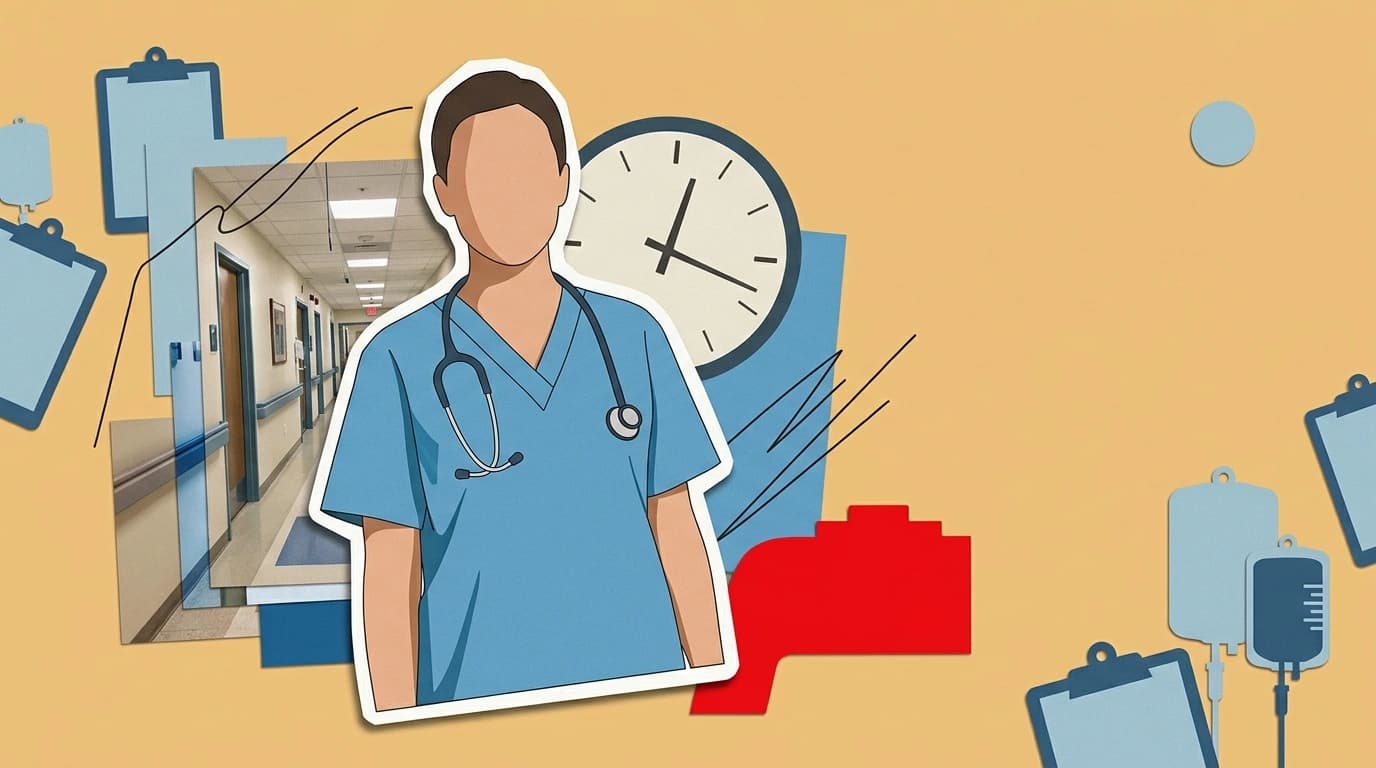
Take a typical ICU night. The central-line care, the medication checks, the actual bedside judgment take fewer minutes than the documentation that records them. The workflow gets interrupted thirty or forty times in a 12-hour stretch by alerts the EMR could have suppressed. By midnight a nurse has been pulled across her own assignment and a piece of someone else's because the unit is two short. The stable patients are not the problem. The apparatus around them is.
That distinction matters because most of what gets sold to clinicians as burnout help is aimed at the clinical work, or at the worker's "resilience." Almost none of it is aimed at the documentation load or the staffing math. And so almost none of it works.
What makes healthcare burnout structurally different
The 2019 National Academy of Medicine consensus report Taking Action Against Clinician Burnout is the single most useful document on this. Its finding, in plain terms: the drivers of clinician burnout are organizational. They have to do with workload design, EHR usability, documentation requirements, scheduling, team structure, and the gap between what care looks like and what care the system permits you to give. Personal resilience is in there, but near the bottom of the list.
A 4:1 patient-to-nurse ratio on a night shift will burn out almost anyone, regardless of how well they slept or how often they meditated. A primary care doctor whose scheduled visit is shorter than the documentation it generates will burn out for the same reason. The number stays put because the cause stays put.
The documentation load is the clearest example of how the structure does the damage. Much of what an electronic health record demands has little to do with care and a lot to do with billing, compliance, and liability: the same fact entered in three places, the click-throughs to acknowledge an alert the system fired for no clinical reason, the after-hours charting that follows clinicians home because there was no time for it during the shift. Each item is small. Stacked across a week, they add up to a second job layered on top of the first one, and it is the second job, not the patients, that most clinicians describe when they describe being burned out.
This is also where the standard burnout advice comes apart. Meditate, take a vacation, set boundaries: those things matter in their own way, and they do nothing to the staffing grid. Maslach's three-axis frame (exhaustion, cynicism, reduced efficacy), which our main piece on burnout recovery lays out, describes what's happening inside the person. The cause is sitting in the operations playbook. A wellness Slack channel cannot redraw a shift.
Moral injury versus burnout, and why the distinction changes what helps
In 2018 two former military physicians, Wendy Dean and Simon Talbot, published a piece in STAT News arguing that the word "burnout" was misnaming what their colleagues were carrying. The Dean and Talbot reframing borrowed a term from combat psychology: moral injury. The harm of being asked, repeatedly, to deliver care below the standard you were trained to deliver, in conditions you can't control.
That reframing changed something. It moved the locus of the problem from "what's wrong with me" to "what's being asked of me." It also explained why the clinicians who care the most about doing the job right tend to break first. They carry the gap.
What actually moves the number, and what doesn't
The 2022 HHS Surgeon General's Advisory on health worker burnout lands in the same place the NAM report does. The interventions that move the burnout number for clinicians are organizational: staffing-ratio reform, EMR and documentation redesign, scribe programs, scheduling autonomy, team-based care that shifts non-clinical work off the clinician, leadership that protects time. The interventions that have weak standalone evidence are the individual ones presented as the fix: mandatory mindfulness, resilience training, wellness apps, gratitude journals at the end of a 13-hour shift.
The contrast is worth handling carefully. Personal practices have their uses. They can help a person endure a situation. Applied to the wrong cause, though, they become a category mistake: a worker is asked to fix a workload problem by adjusting her breathing, and the math doesn't agree.
Where individual decisions still matter is in deciding what to do about the situation. Leaving a system that won't change. Switching specialties. Moving from ICU to clinic, from hospital to outpatient, from acute to community. Organizing inside the institution. None of those are easy. All of them do more work than any wellness program.
What the structural change usually looks like
For most clinicians, the structural fix is undramatic. It is rarely a memoir or a career reinvention. A common version: an ICU nurse transfers to a community clinic at a 20% pay cut, gets her sleep back inside six weeks, and six months later is running diabetes group education two clinic days a week plus a half-day Friday. The pay cut hurts for the first year and then stops mattering. What changed was the unit and the employer, not the person.
That is the shape of most real recoveries: a quieter unit, a different specialty, a move from acute to outpatient, or a different institution altogether. Almost never is it a return to the same role under the same conditions while expecting the week to feel different. For most clinicians, the cause is the system they work inside, not a shortfall in themselves, and the change that helps is a change to the conditions, not another wellness program added on top of them.
References
- National Academies of Sciences, Engineering, and Medicine. (2019). Taking Action Against Clinician Burnout: A Systems Approach to Professional Well-Being. Washington, DC: The National Academies Press. nationalacademies.org.
- Talbot, S. G., & Dean, W. (2018, July 26). Physicians aren't 'burning out.' They're suffering from moral injury. STAT News: statnews.com.
- U.S. Department of Health and Human Services, Office of the Surgeon General. (2022). Addressing Health Worker Burnout: The U.S. Surgeon General's Advisory on Building a Thriving Health Workforce. Archived at NCBI Bookshelf: ncbi.nlm.nih.gov/books/NBK595228.