How burnout affects the body: sleep, immunity, and what to check first
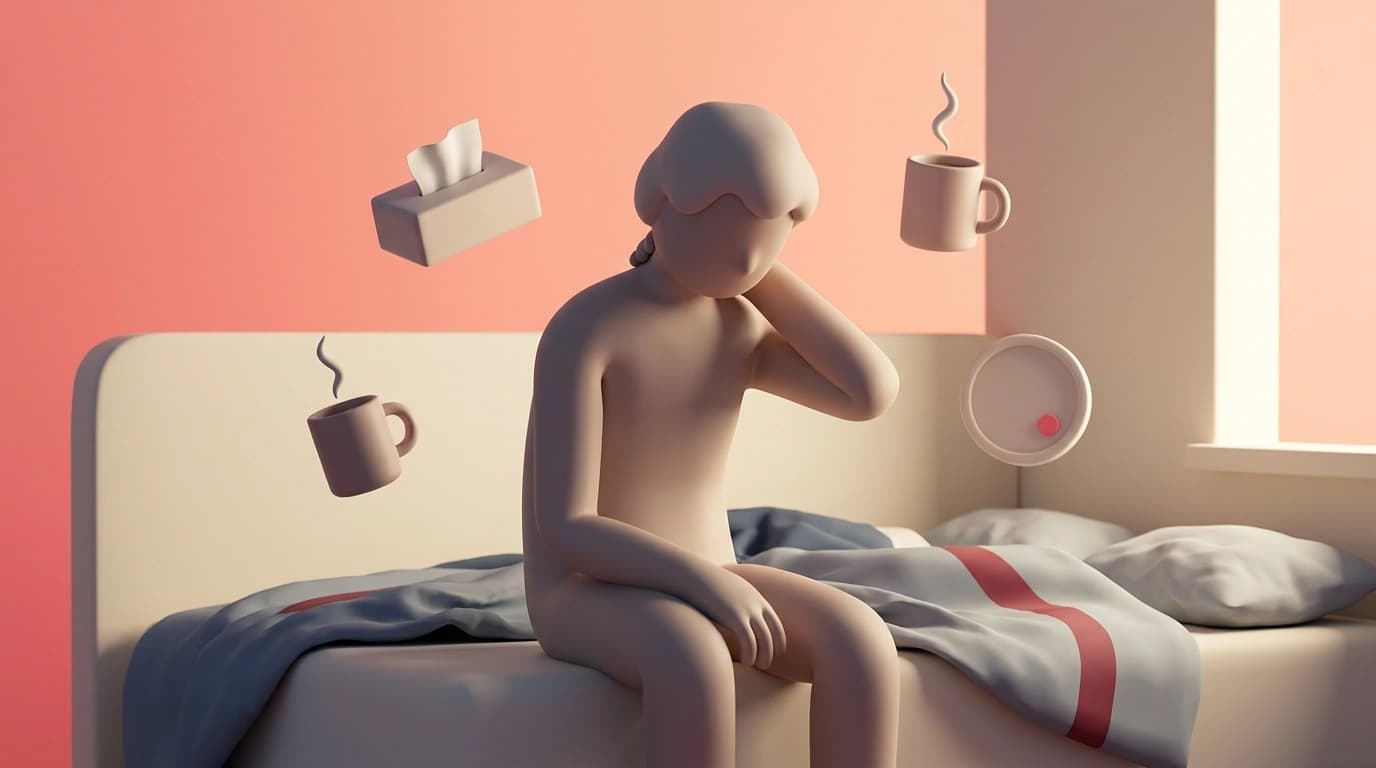
I sat in my GP's office in Atlanta in January 2023 asking whether adults were supposed to get sick this often. It was the third cold since November, or really the same cold coming back for a rematch. My right shoulder had been knotted for four months. That was when the exhaustion dimension of burnout finally sent me somewhere.
How burnout affects the body: the somatic version is duller than the wellness-industry version wants it to be. It shows up as sleep architecture drift, immune dips, gut motility changes, and low-grade musculoskeletal tension. Most of it is boring. Most of it arrives before anyone thinks the word "burnout."
I'll admit I'd been reading my own state on the exhaustion axis alone, and reading that badly.
The first signs are small and boring
The body announces burnout quietly. Popular writing about the condition leans on the collapse story: the panic attack on the flight, the crying in the parking lot. Those read well. The actual announcement is smaller and duller. It's a shoulder that stays knotted through the second and third massage. It's the fourth 4 a.m. wake-up in one week. It's the cold you catch in November that you're still coughing through in late January.
Every one of those was on me for about three months before I noticed the pattern. My spouse noticed first. She said sometime in early December 2022 that I hadn't finished a book in six weeks, and I had been reading for an hour every night. That was the sentence that stuck.
The reason the dramatic version dominates the writing is that it makes better copy. The reason the dull version matters more is that most burnout gets caught, if it gets caught, in the dull version. If you're trying to answer what does stress burnout feel like in your own body, you're looking for something less cinematic than a breakdown. You're looking for a small drift across a set of low-signal markers.
What the exhaustion dimension actually does to sleep
The exhaustion axis registers first in sleep, and usually not the way you'd expect. The most common burnout sleep pattern, and the one I got, is early-morning waking. You fall asleep fine at eleven. You wake around 4 a.m. with a jolt and a to-do list. The underlying architecture of sleep has shifted, even though your bedtime hasn't.
The mechanism most likely involved is a blunted cortisol rhythm. In healthy adults, cortisol rises steeply in the last hour before waking (the "awakening response") and falls across the day. Under chronic occupational stress, that morning rise flattens and the evening trough rises. The Wikipedia page on occupational burnout summarizes the HPA-axis literature and its findings on cortisol dysregulation across burnout and adjacent conditions, which is a good starting point if you want the endocrine version.
Salvagioni's 2017 systematic review of the physical consequences of burnout notes that the sleep findings across studies are mixed. Some studies find a clean insomnia signal; some don't. That is worth knowing. The sleep effect is real; the shape varies across people. Some get bedtime insomnia; more get the 4 a.m. version I got; a smaller group sleeps ten hours and still wakes exhausted. All three are burnout signatures.
Colds that don't clear, a stomach that keeps score
The immune and gut effects are where can emotional exhaustion make you sick stops being an abstract question. The same Salvagioni review documents higher rates of flu-like illness, common cold, gastroenteritis, musculoskeletal pain, and gastrointestinal problems in burned-out cohorts across the studies it pooled. The review also finds consistent associations with cardiovascular disorders and reduced life expectancy in severe cases. Those are the tail-risk endpoints, and they take years, not months, to develop.
The everyday version is more mundane. You get the cold everyone in the office got, and instead of shaking it in five days you shake it in eighteen. Your gut becomes noisier: you notice which foods are giving you trouble in a way you didn't a year ago. Your right shoulder, or your neck, or wherever your body stores tension, gets tighter, and the deep-tissue appointment that used to fix it now buys you maybe three days.
If you're looking for a burnout symptoms physical checklist, one grounded in actual clinical research, start with the review's list of consistent findings. Three or more common-cold episodes in a rolling six months. Gastrointestinal trouble that wasn't there a year ago. Headaches at a new baseline frequency. A specific musculoskeletal knot that outlasts massage or PT. Three of those clustering for six or more weeks is the pattern worth naming.
Why the body reads it before you do
How burnout affects the body is really a story about the exhaustion axis in specific. That axis sends physical signals before the cynicism axis becomes conscious to you. It was the sequence I saw in myself: the physical signals arrived first, and the "why am I still doing this job" question showed up about eight weeks later. By the time you notice you're cynical about a job you loved a year ago, the body has been running the signal for a while.
How burnout affects the brain is part of the same story: attention narrows, working memory dips, and the HPA-axis dysregulation above shows up as a specific flavor of tired-but-wired that most people know if they've had it. The World Health Organization's classification of burnout as an occupational phenomenon, added to ICD-11 in 2019, is deliberate about naming it occupational rather than clinical. The condition responds to changes in the work situation.
What that means for the body: treating the shoulder or the cold or the sleep in isolation, without touching the job, rarely closes the loop. The symptom is downstream of the axis. For the structural version of what actually changes it, our main piece on burnout recovery walks through the three axes and what the research supports.
The reason to see your doctor is the opposite of what you'd think
A GP visit at this stage is a rule-out exercise. The point is to check the four or five other conditions that produce every marker in the paragraphs above. Low thyroid. Iron deficiency, particularly for menstruating women in their late 30s and 40s. Undiagnosed sleep apnea. A residual viral fatigue from an infection three months prior. Vitamin D at the low end. Any one of them can look like burnout, and each has a specific treatment that has nothing to do with your job.
My own GP that January 2023 ran a broad panel. Thyroid was fine. Ferritin was borderline low. Vitamin D was in the ditch. He also asked, without being prompted, how work was going, and I heard my own answer come out flatter than I meant it to. That answer was more diagnostic than the panel.
If four consecutive weekends of real rest still leave you starting Monday the way you finished Friday, and if two or three of the somatic markers above have been running for six weeks, book the physical. Get the blood panel that catches thyroid, iron, and vitamin D at the same time. It is worth knowing whether the burnout is the whole story or part of a stack.
Which is a different kind of adult errand than most of us are used to running.
References
- Burnout an "occupational phenomenon": International Classification of Diseases. World Health Organization, 28 May 2019.
- Salvagioni DAJ, Melanda FN, Mesas AE, González AD, Gabani FL, Andrade SM. Physical, psychological and occupational consequences of job burnout: A systematic review of prospective studies. PLOS ONE, 4 October 2017; 12(10): e0185781.
- Occupational burnout. Wikipedia article summarizing HPA-axis, cortisol, and somatic-symptom research.