Stay at home parent burnout: the structural test and what actually moves it
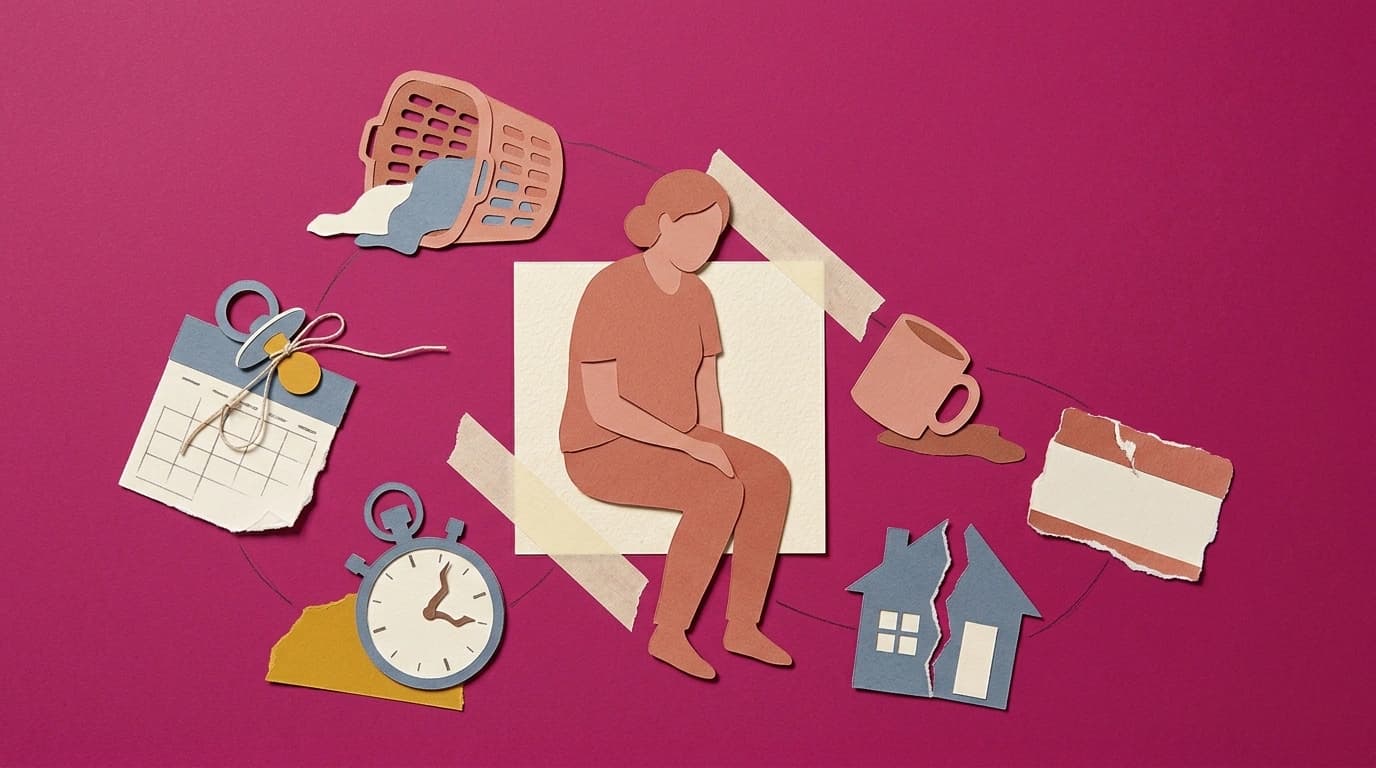
Ask a room whether burnout applies to someone who does not get paid, and half the room will say no. Occupational-health researchers would say yes. The paycheck was never the load-bearing element of the syndrome.
The Maslach three-axis model, the framework most researchers still use and the basis for the WHO's 2019 addition of burnout to ICD-11, measures exhaustion, cynicism toward the role, and reduced sense of accomplishment. None of the three requires a W-2. Stay at home parent burnout is real occupational burnout by every structural test the model was built to run. What the caregiving version adds is a set of signatures the original inventory was not designed to catch.
Yes, occupational burnout applies without a paycheck — here's the structural test
The WHO's 2019 ICD-11 update classifies burnout as an occupational phenomenon and points to Christina Maslach's three-axis structure. Read the word carefully. "Occupational" means arising from a role, not arising from paid employment. That distinction matters when the role is caregiving.
Run the same test a researcher would run:
- Exhaustion axis. Is there emotional depletion that sleep and a weekend do not reset? For most caregivers past the first year at home, yes, with the caregiving twist that "the weekend" does not exist as a category of time.
- Cynicism axis. Has the tone shift arrived? The internal muttering when the toddler needs one more thing, the flatness when reading books that used to feel warm. The same axis 2 signature shows up in nurses, teachers, and product managers.
- Reduced-accomplishment axis. Does output continue while the sense that any of it matters has faded? Caregivers often score worst on this axis, because the work has no shipping metric.
If two of three axes are elevated for a couple of weeks, that is the structural pattern regardless of who signs the paycheck. What is stay at home mom burnout, structurally? This. What is stay at home dad burnout? The same pattern. For the full three-axis walk-through in the paid-work version of the same condition, see our main piece on burnout recovery.
The four caregiving-specific signatures the Maslach Inventory wasn't built to name
The original 1981 Maslach Burnout Inventory was calibrated on human-services professionals: nurses, social workers, teachers. It caught the three axes cleanly in paid roles with a formal end-of-shift. Caregiving at home warps the same axes in four specific ways the paper inventory does not have items for.
1. The infinite shift. Paid burnout research assumes an off-duty state. Caregiving has no clock-out. The stay at home parent exhaustion signs most often reported by parents themselves (the 3 a.m. wake-up that ends the sleep-debt recovery cycle, the "off-duty" hours that get re-classified mid-Saturday as duty hours) are functionally an infinite-shift version of what the inventory calls emotional exhaustion.
2. Solo cognitive load. Nurses have coworkers. Teachers have staff rooms. The at-home caregiver frequently has neither, especially in the toddler window. The load includes not only the caregiving itself but the logistics wrapped around it: meal planning, pediatrician calendars, developmental milestones, wardrobe rotation, playdate scheduling. Research on cognitive household labor finds this component distributes unequally in most heterosexual partnerships.
3. Zero external status signal. A promotion, a bonus, a job title change: most paid roles have some form of periodic external validation, even a weak one. Caregiving has almost none. The reduced-accomplishment axis is unusually easy to slide down when nobody outside the household is scoring the work.
4. The exit-cost cliff. Employees can quit a job. Caregiving parents cannot quit the child. What they can restructure is the shape of the role, which is a much harder problem and one most burnout playbooks were not written for.
That is what stay at home mom burnout signs typically add up to. Catalogued from the inside, what does stay at home mom burnout look like? Exhaustion inside an infinite shift, run alone, unrewarded by external status, and structurally impossible to exit.
How this differs from a postpartum mood condition (and how to tell)
Two conditions can look similar from outside and require very different responses. A stay at home parent burnout profile is occupational: it tracks the shape of the role, tends to improve when the role changes, and typically does not involve pervasive flat mood across domains outside the caregiving load. A postpartum mood condition is clinical: it can appear regardless of role satisfaction, may involve flat mood or intrusive thoughts across contexts, and responds to clinical treatment rather than role restructuring. The WHO's ICD-11 wording is explicit that burnout is occupational and separate from mood disorders.
The rough day-to-day cut: burnout responds to structural change in the caregiving load; a clinical mood condition often does not. If a caregiver can identify a specific week last month when a childcare shift or a partner's return from a work trip meaningfully lifted the mood, that is the burnout pattern responding to load reduction. If nothing shifts the mood, that is a signal that the frame might be wrong.
If that distinction is hard to make from the inside, that is the moment to talk to a doctor.
Three structural moves that actually move the number
How to recover from stay at home mom burnout is a structural question. The Maslach research and the WHO's ICD-11 framing agree on the same underlying point: burnout responds to structural change in the role, and inner reframing alone rarely closes the gap. Three moves show up consistently in what caregivers who came out the other side describe.
Move 1: Purchase back predictable off-duty time. A specific block, on the calendar, weekly, that is protected by someone else being on. Two hours on Tuesday morning and four hours on Saturday afternoon is more useful than an occasional break. The regularity is what does the work, because the exhaustion axis softens on rhythm, not on rare peaks.
Move 2: Redistribute the cognitive load, in writing. The mental-load research is clear that "just ask" does not scale. A written list of every recurring household and caregiving task, then a named owner for each, moves the needle on the reduced-accomplishment axis by making invisible work visible. Couples who do this once a quarter report the redistribution shifts the burnout profile within weeks.
Move 3: Rebuild an external identity anchor. A weekly in-person class, a volunteer commitment with a fixed schedule, a small part-time role: six to ten hours a week outside caregiving that is not more caregiving in another form. The purpose is re-establishing that the person exists in the world with a role that has a beginning and an end. Income is beside the point.
None of the three requires a nanny, a sabbatical, or a career pivot. All three require the household to acknowledge that the caregiving parent has an occupation, with the same axes as any other, and needs the same structural adjustments any burned-out worker would need.
Why this one can't be fixed from inside the house
Stay at home parent burnout tends to persist longer than the paid version for one structural reason. The paid version has organizational pressure valves: HR, a manager, a promotion clock, PTO policy, colleagues who will ask if you are okay. The unpaid version has none of those built in.
Every structural move above requires someone else to change their behavior. The working partner has to buy back the two hours on Tuesday. Extended family or paid help has to cover the Saturday block. Both partners have to sit with the redistributed task list and stop treating logistics ownership as invisible. The external identity anchor requires the caregiving parent to leave the house at a time when the household would often prefer they did not.
The internal moves (better sleep hygiene, less scrolling, a journal) sit inside the caregiving parent's control and are usually already being attempted. They rarely reach threshold because the load-bearing structure is the shape of the role itself.
That is the version of stay at home dad burnout, and stay at home mom burnout, that the wellness industry rarely wants to sell: recovery is a household negotiation. For the broader recovery frame that applies once the structural work begins, the 2022 U.S. Surgeon General's Advisory on health-worker burnout uses the same three-axis Maslach framing in a different under-compensated caregiving context, and our main piece on burnout recovery walks the recovery pattern in the paid-work version of the same condition.
References
- World Health Organization. 2019. "Burn-out an occupational phenomenon: International Classification of Diseases".
- Office of the U.S. Surgeon General. 2022. "Addressing Health Worker Burnout: The U.S. Surgeon General's Advisory on Building a Thriving Health Workforce".