Cold Plunge Misogi: When It Counts and When It Doesn't
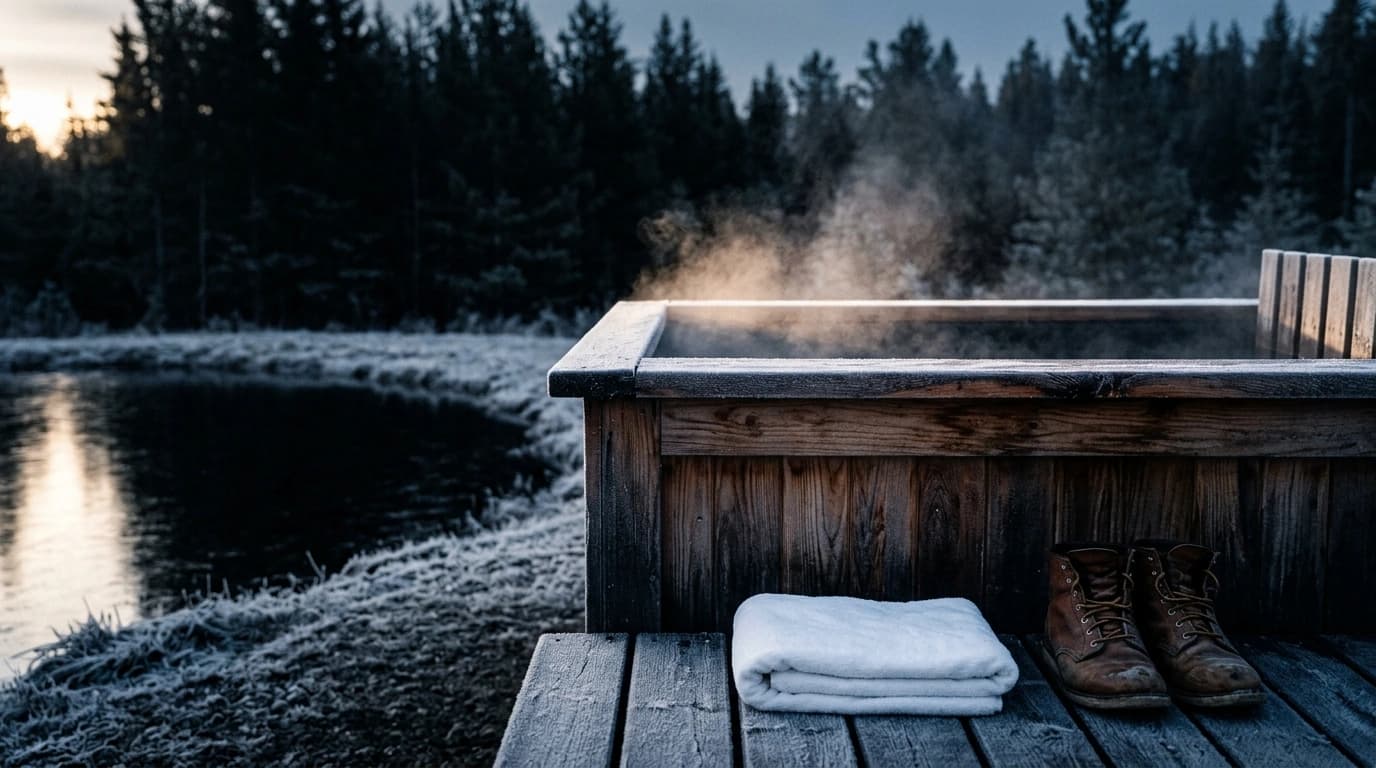
No — one plunge is not a misogi. A season of cold water can be.
One cold plunge fails the two tests that structure the modern misogi: the once-per-year scope, and the fifty-percent doubt bar. A single Saturday plunge, a weekly plunge, or a rolling bathhouse sauna-and-plunge rotation belongs to the category of hygiene practice. Beneficial, sustainable, useful for building baseline cold tolerance, and outside the misogi frame entirely.
A structured cold-water season across a full winter is a different candidate. If it takes you into open water at temperatures your baseline forbids, if the completion rate sits close to half, if it sits as a single event on your annual calendar, if it belongs to you rather than an audience, and if the format leaves no easy exit clause, it can clear the five criteria that Marcus Elliott and Jesse Itzler use to define the American practice (see our full breakdown of what a misogi actually is).
How the five-criterion test cuts through cold water
The question of cold plunge as a misogi runs into the five-criterion test: (1) chosen difficulty, (2) roughly fifty-percent doubt of completion, (3) once-per-year scope, (4) personal and non-performative, (5) no built-in quit clause. Cold-water candidates fail these in different places.
Chosen difficulty is the easy one. A cold-water plunge at temperatures the body did not evolve to tolerate is difficulty, chosen. The trouble starts at criterion two. Most single-plunge sessions have a completion rate close to 100% for anyone who owns swim trunks; the misogi cold plunge diagnostic asks whether the completion probability sits close to half, and single sessions almost never survive that question.
Criterion three, once-per-year, kills nearly every "cold plunge is my misogi" claim on its own. A weekly hygiene practice cannot also be the annual event. Criterion four cuts against most bathhouse and social-media plunge culture, where the audience is often the point. Criterion five, the no-quit clause, is where recreational cold water most cleanly fails: at a bathhouse or your own tub, you exit whenever you decide the sensation is enough.
Michael Easter's The Comfort Crisis is the popular source that put this framing in front of American audiences, though the criteria themselves belong to Elliott's training-load logic rather than to any single book chapter.
Three cold-water shapes that pass all five
A full winter of daily open-water immersion. A practitioner commits to a documented daily plunge through a real winter, in an unheated natural body of water where surface temperatures drop into single digits Celsius. Chosen difficulty is extreme in the coldest weeks, when a five-minute immersion demands specific breathing protocol. Fifty-percent doubt holds for anyone whose baseline is a shower, given the compound effect of streak pressure, mid-winter storms, travel, and illness. Once-per-year holds because the winter season is the event, and a person cannot do two winters in one calendar year. Personal-not-performative is satisfied if the plunge is not photographed for an audience. The no-quit clause is baked in: miss a day, the streak breaks, the year does not count. This is the shape closest in spirit to the Shinto original.
A documented ice-mile swim. The International Ice Swimming Association certifies ice-mile attempts at water temperatures of 5.0°C / 41.0°F or below, under witnessed protocol, in standard costume with a silicon cap and no wetsuit. Chosen difficulty is enormous. Fifty-percent doubt holds for a first-time attempt by a swimmer whose comfort zone is a heated lap pool, and the certification standards are stringent enough that unprepared swimmers are quietly turned away before the start. Once-per-year fits naturally, because recovery from a genuine ice-mile attempt is measured in weeks. Personal is optional and often actively enforced by the sanctioning body's low-key ethos. The medical-clearance requirement acts as a quit-clause blocker rather than an easy exit: no clearance, no attempt.
A hundred-day polar-plunge streak across the winter. A person commits to a single unbroken 100-day sequence of open-water immersion, witnessed by at least one accountability partner, at any natural body of water they can reach on foot from home. The streak passes through the coldest weeks of the year. Chosen difficulty scales with location: a 100-day streak in a Boston pond in January is a different event than a 100-day streak in San Diego surf. Fifty-percent doubt holds when the practitioner reckons with their starting point. Once-per-year holds because a second attempt in the same calendar year is redundant. Missing a day resets the count to zero, so the no-quit clause is baked into the structure. The Coney Island Polar Bear Club, the oldest winter bathing club in the United States (founded 1903), holds a public New Year's Day plunge that many streaks anchor around. The streak itself is private.
Three that look like a misogi but aren't
Anyone with a cardiovascular condition, or on medications affecting blood pressure or arrhythmia, needs medical clearance before any cold-water immersion; nothing in this article substitutes for that conversation.
A single cold-plunge session. One Saturday morning at a fitness studio, or one three-minute barrel plunge on a company retreat. The event is bounded and physically real. It fails once-per-year scope in almost all real usage, because the same practitioner does another session the following weekend, or the next month, and the singular-annual character never gets built. It also fails the personal-not-performative bar because the plunge is usually photographed. A hygiene ritual with a photo.
Rolling sauna-and-cold-plunge rotation at a bathhouse. A sustainable weekly practice at a Russian, Finnish, or Korean bathhouse, cycling between hot rooms and a cold plunge. Chosen difficulty is soft, because the plunge is short, the exit is one meter away, and the sauna is next door. The no-quit clause is absent by design. The practitioner leaves the plunge the moment sensation becomes uncomfortable, which is the correct thing to do at a bathhouse and disqualifying for a misogi.
A Wim Hof introductory course or weekend cold-immersion retreat. These formats are engineered for a high completion rate. The coach's job is to get the participants through the practice, and the practice is designed accordingly. The fifty-percent doubt bar cannot survive a design whose success rate is deliberately much higher. The retreat is a good on-ramp to cold-water practice. It is not, in the Elliott sense, a misogi.
The knot in the word itself.
In Shinto, misogi is cold-water purification. The word originally denotes what a practitioner is doing when they stand under a waterfall in winter, chanting harae. The kanji is 禊. The technical term for the water form is mizugori (水垢離). The popularized American use of the word is roughly a decade old.
So of all the modern American misogis (desert sandbag carries, fifty-kilometer trail runs, long open-water crossings), the structured cold-water season is the one where the modern practice and the thousand-year-old ritual share the most obvious lineage. Both are voluntary cold immersion in natural water. Both mark a threshold. Both are undertaken in a spirit distinct from the fitness-industry framing that has swallowed most of the popular discussion. The Wikipedia entry on Misogi as a Shinto purification ritual is a good starting map for readers curious about the ritual itself; our fuller treatment of the Japanese lineage covers where the borrowing sits.
Which meaning is running in a given practitioner's head, the Shinto one, the Elliott one, or some private synthesis of the two, depends on how the practice is held. A cold plunge misogi held in the Shinto spirit becomes something closer to mizugori than to fitness. Held in the Elliott spirit, it becomes a calibration event against the practitioner's baseline. Both readings are older than the fitness-industry version.
References
- Easter, M. (2021). The Comfort Crisis: Embrace Discomfort to Reclaim Your Wild, Happy, Healthy Self. Rodale Books.
- International Ice Swimming Association. Ice-mile rules and certification protocol (linked inline).
- Coney Island Polar Bear Club. Public New Year's Day plunge; oldest winter bathing club in the United States, founded 1903 (linked inline).
- Wikipedia contributors. "Misogi" (Shinto purification practice, kanji 禊); linked inline.