Hobbies for Men in Their 40s: Five Categories That Actually Work
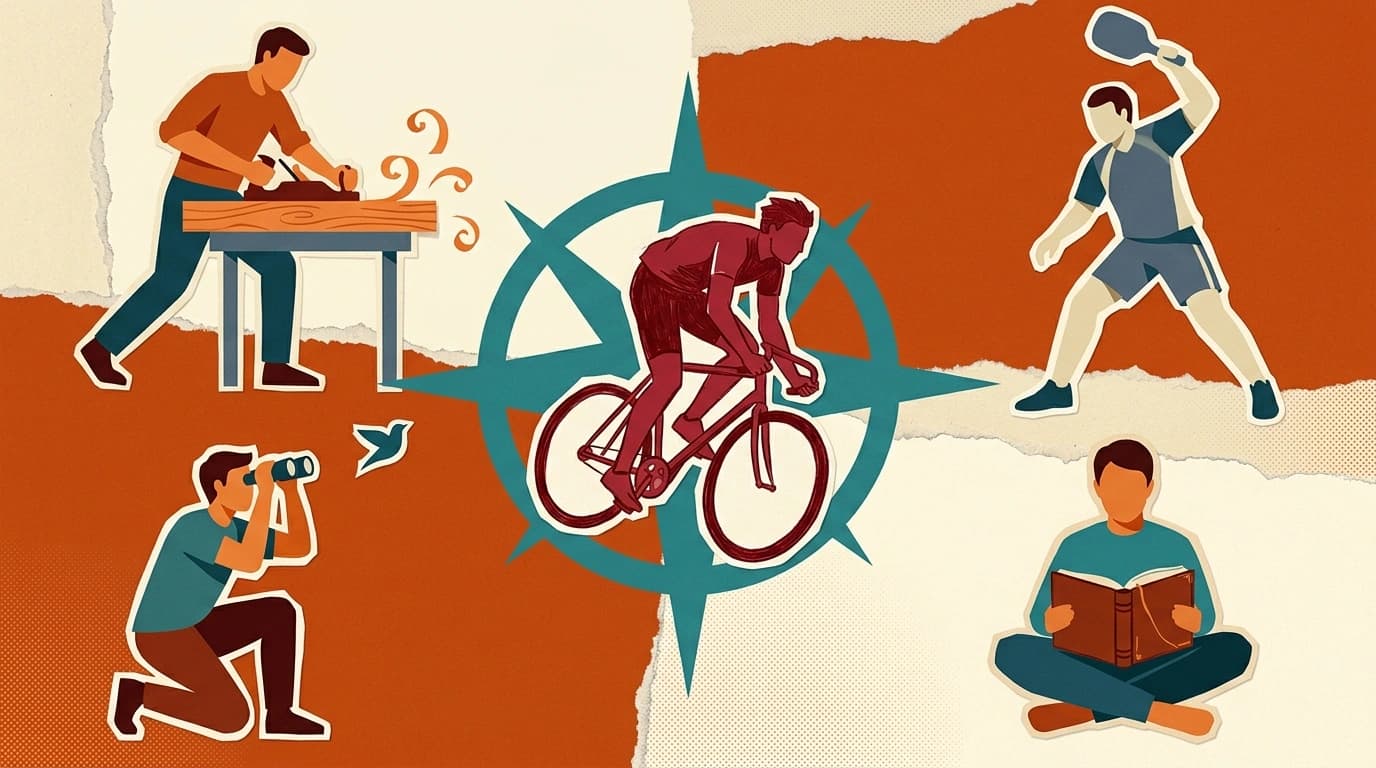
The advice about hobbies at forty often arrives in the same shape as the advice at twenty-five, with a slightly slower tempo dropped in. That misses what actually changes. Three specific constraints tighten in the fourth decade — physical recovery, social geography, and available attention — and each one changes which hobbies for men in their 40s pay back the effort and which slowly punish it. The definitional ground on what a hobby actually is, and why adults quietly lose them, lives in the cornerstone on hobbies for adults.
Three constraints that shape the shortlist at forty
The first constraint is physical recovery. Cartilage, tendon, and connective tissue reset more slowly at forty-two than at twenty-five. This does not rule out contact sport or heavy lifting; plenty of men in their forties squat and roll well. But any hobby which relies on ligament-shredding movement patterns will accumulate injuries that stay. The activities that survive tend to be those with a low-impact profile or those where technique carries a larger share of the load.
The second constraint is social geography. The default friend group thins in the fourth decade for reasons well documented in adult friendship research: geographic moves, marriage-and-kids sorting, and the loss of the ambient work-and-school proximity that made twenty-something friendship free. New friends after forty need engineering. A repeating shared activity puts the same men in the same room every week, and that is where new adult friendships tend to originate. A hobby that fixes this problem is worth more than one that leaves it alone.
The third constraint is available attention. The energy left over after a working day and any caregiving duty is a smaller reservoir than it was, and it fragments across a phone and a laundry list. Hobbies that demand a two-hour unbroken block on a weekday will fail. Hobbies that fit into a protected sixty minutes, or that hold attention because they are absorbing rather than draining, will survive.
Two categories that work with a slower body: low-impact endurance and craft with a finished object
Low-impact endurance is the first survivor category. Cycling, swimming, hiking, rowing, and trail running on soft surfaces (for the runners who cannot let it go) all fit the physical-recovery constraint cleanly. The activity delivers the absorbed rhythm that Csikszentmihalyi mapped in his 1990 book Flow: a state where challenge and skill line up long enough to make the mind quiet. The trade-off is that these hobbies are typically solo. They pay back on the body and on the head; the friend-group problem stays untouched.
Masters cycling and masters swimming programs offer a social dimension inside the low-impact frame. Weekly group rides and pool squads pull men in their forties into a fixed slot with the same faces. On the mechanics of the mind-quieting rhythm itself, see the Wikipedia entry on flow psychology.
Craft with a finished object is the second survivor. Woodworking, leatherwork, hand-tool restoration, bread-baking, home repair-and-build, cast-iron cooking, and analog metalworking all belong here. What they share is a physical thing at the end of the session (a shelf, a loaf, a sharpened chisel) that acts as an anchor against the drift of a screen-heavy adult week. The pull of a completed object fits what the sociologist Robert Stebbins called serious leisure: the amateur pursuit substantial enough to build identity around.
These are also affordable hobbies for men in their 40s in a way the specialist-gear world is not. A basic hand-tool kit and a workbench built from framing lumber runs a few hundred dollars. The hobby scales up over years, but the beginner-friendly version demands modest capital and stays there for as long as the practitioner wants.
The one category that fixes the friend-group problem: a team sport at a low barrier
The activity most often missing from mid-life hobby lists is the one that solves the friendship problem best: a team sport played at a genuinely low intensity threshold. Weekly pickup basketball, over-40 recreational soccer leagues, adult ice hockey C or D divisions, ultimate frisbee summer leagues, and (increasingly common in North America) over-40 pickleball round-robins all deliver what the solo hobbies leave undone. The same men show up on the same night for a season, share the same drills and the same in-jokes, and the friendship builds by accident because the calendar keeps forcing the meeting.
The barrier that keeps most men out is the assumption that they need to be good. Recreational leagues exist precisely because everyone who joins them was, at some point, the worst player on the roster and stayed anyway. Ambition is a poison here; showing up on time is the only serious requirement.
If the reader is asking what hobbies should i pick up in my 40s, the practical answer is: whatever else, add one that puts the same men in the same room every week. The other categories work on the body and the mind. The team sport works on the calendar of adult friendship.
Two threads for the intellectual and outdoor itches
Two more categories deserve a spot on the shortlist because they scratch itches the categories above leave alone.
The intellectual thread. Chess, go, bridge, language study, amateur history, astronomy, ham radio, and analog photography all deliver the slow satisfaction of a skill that deepens for decades. The distinctive feature at forty is that these hobbies benefit from the specific advantage midlife brings: patience, tolerance for slow gains, and comfort with the beginner mistakes that would have felt humiliating at twenty. A forty-two-year-old learning chess reads more calmly than a twenty-two-year-old with the same starting board, because he shrugs at losing his queen in the first ten moves. The identity is less brittle at forty, and the game deepens accordingly.
The outdoor thread. Fly fishing, upland bird hunting, sea kayaking, backpacking, foraging, and bird-watching (the sleeper category) all put the practitioner into wide landscapes on a repeating schedule. The American Time Use Survey tracks outdoor leisure as its own category, and outdoor time restores attention in ways an indoor gym slot cannot.
Bird-watching in particular is worth a note as one of the most satisfying new hobbies for men in their 40s. It is cheap to start (a mid-range pair of binoculars covers most of the entry cost), and it scales to whatever depth the practitioner brings.
Three hobby shapes to walk straight past
Three shapes appear repeatedly on hobby lists aimed at middle aged men, and each one reliably disappoints. Any list of hobbies for 40 year old men should mark these as traps.
The first is the high-impact resurrection. This is the man in his forties who decides to return to something that broke him at twenty-five: full-contact martial arts at a competitive gym, weekend warrior tackle football, singles racquetball at a pace the knees will not honor. The activity itself works fine. What breaks the knee is choosing an intensity level built for the man who last played at twenty-five. Any of these done at 60 percent effort, once a week, in a low-stakes club, works. The failure mode is bringing twenty-five-year-old ambition to a forty-two-year-old body and buying a torn meniscus by month four.
The second is the monetized side project disguised as a hobby. This one arrives dressed as pragmatism: since the hobby will take time, why not build a small business out of it? The overjustification effect that Edward Deci documented starting in 1971 catches this hard. The Etsy shop, the YouTube channel, the weekend consulting gig: each of these can be a good project on its own terms. They also tax the productivity faculty that already runs the working week, so a hobby shortlist has nothing to gain from adding them.
The third is the solo screen hobby. Video games, digital collecting, and long-form podcast consumption all deliver a version of engagement, but they fail the social geography constraint and they add screen time to a life already saturated with it. They work as a Sunday-evening decompression. A shortlist that survives the decade needs anchors those three cannot give.
The catalogue of durable hobbies for men in their 40s runs shorter than most lists suggest. The five categories above already cover most of what will still be around at fifty.
References
- Csikszentmihalyi, Mihaly. Flow: The Psychology of Optimal Experience. Harper & Row, 1990. flow psychology
- Stebbins, Robert A. Serious Leisure: A Perspective for Our Time. Sociological framework, 1982 onward. serious leisure
- U.S. Bureau of Labor Statistics. American Time Use Survey. Ongoing annual survey. American Time Use Survey