Hobbies for Adults: Why We Lose Them and How to Get One Back
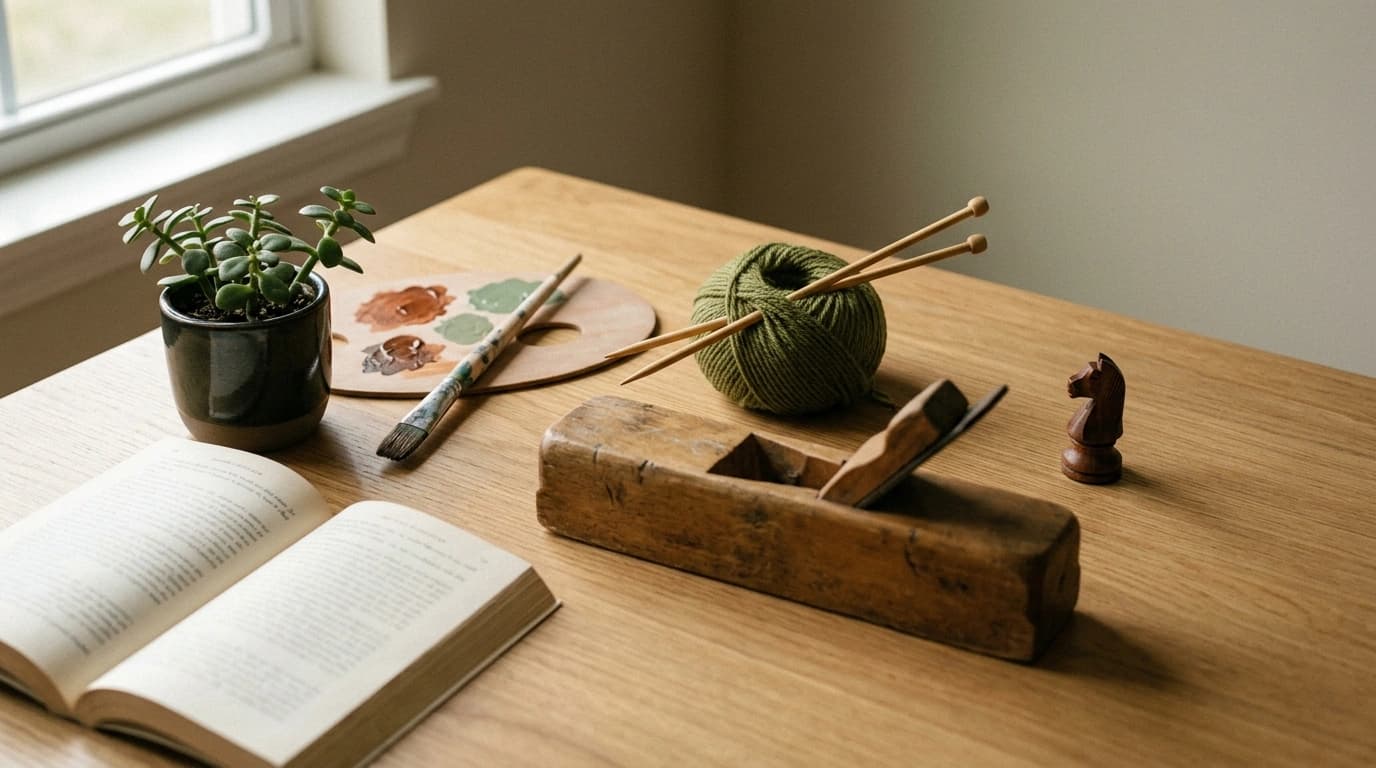
Ask a room of working adults what they do for fun and watch how many reach for their job, their kids, or something with a payoff. The honest answer is often a pause. Somewhere between graduation and the mortgage, a lot of people quietly stopped doing things for no reason at all. Hobbies for adults are the activities you do purely because you enjoy them, with no scorecard attached and nothing to sell at the end. This piece is about where they go, why they matter more than they look like they do, and how to get one back without turning it into another project you have to manage.
What actually counts as a hobby
Start with a clean definition, because the word has gotten slippery. A hobby is an activity you pursue for its own sake. The doing is the point. There is no external metric of success, no client, no finish line that someone else grades.
The psychologist Mihaly Csikszentmihalyi called this kind of experience autotelic, from Greek roots meaning "self" and "goal." In his 1990 book Flow, he described activities that carry their reward inside the activity itself, the way a rock climber climbs the wall to climb the wall, not to reach the top and leave. You can read more about the psychology of flow and how absorption works, but the core idea is simple: some things are worth doing even though they produce nothing you can hold up afterward.
That definition quietly excludes a lot of what modern adults file under "hobbies." A side hustle has a metric, revenue. A self-improvement project aims at a future version of you, a flatter stomach or a marketable skill. Exercise done purely as obligation, the joyless treadmill you endure because you should, sits closer to a chore than a hobby. None of these are bad. They are just doing a different job. The tricky part is that a real hobby and a productivity project can look identical from the outside. Two people knit the same scarf. One is relaxing; the other is building an Etsy inventory and tracking margins. The yarn is the same. The experience is not.
Robert Stebbins, a sociologist who spent decades studying how people fill their free time, drew a useful line between casual leisure and what he named serious leisure, the systematic pursuit of an amateur or hobbyist activity substantial enough to build a small identity around. A casual hobby is a crossword on the train. Serious leisure is the amateur astronomer who knows the sky, or the woodworker with a garage full of chisels. Both count. Both do the thing hobbies are for. The distinction just tells you how deep the roots go.
Why adults quietly stop
Nobody decides to quit their hobbies. There is no ceremony. The guitar migrates to the closet, the running shoes stop getting used, the sketchbook fills up to page nine and stalls. Why adults stop having hobbies is less a single choice than a slow squeeze from four directions.
The first is genuine time scarcity, and it is worth being fair about this rather than scolding people for wasting their evenings. The American Time Use Survey run by the U.S. Bureau of Labor Statistics finds that Americans do report several hours of leisure on an average day. The catch is where it goes. The largest single chunk, by a wide margin, is watching television. When you subtract screens, caregiving, and the residue of a workday that follows you home on a phone, the true open space for a deliberate hobby shrinks to slivers. The time exists on paper. It rarely arrives in usable blocks.
The second pressure is optimization culture, the quiet assumption that unstructured time is time wasted. If an hour cannot be shown to build your body, your income, or your brand, it starts to feel indulgent. Adults raised on this logic feel a small guilt when they do something that produces nothing. So they either skip it or bolt a goal onto it until it is no longer a hobby at all.
The third is the pressure to monetize. The moment anyone gets modestly good at a thing, a chorus arrives: you could sell that, you could teach that, you could start a channel. Turning a hobby into income sounds like a win. Often it quietly kills the reason the hobby worked, a point worth its own section below.
The fourth is identity and the "too old, too bad at it" barrier. There is a widespread belief that hobbies belong to childhood, that a serious adult has outgrown the beginner's clumsiness. Picking up the violin at forty means being visibly bad at something in front of yourself, and that stings in a way it did not at nine. So people avoid the whole category rather than tolerate the awkward early weeks. Hobbies for grown ups get quietly reclassified as things you used to do.
The research on why leisure matters
It would be easy to treat all this as a soft, nice-to-have concern. The evidence says otherwise. Leisure that a person genuinely enjoys tracks with measurable differences in how the body and mind are doing.
The clearest single study here comes from Sarah Pressman and colleagues, published in Psychosomatic Medicine in 2009. Their work on enjoyable leisure activities surveyed adults on how often they took part in pleasant, absorbing pastimes, then looked at both psychological and physical markers. People who engaged in more of these activities showed lower blood pressure, lower cortisol, smaller waistlines, and better psychological function, including more positive mood and less depression. The design cannot prove that hobbies cause all of this, since happier and healthier people may also do more of what they love. But the association is consistent and it points the same direction across several independent measures.
There is also a motivational layer. Positive psychology has spent years mapping what a good life is actually made of, and hobbies land squarely inside it. Martin Seligman's PERMA model breaks wellbeing into five parts, and two of them, Positive emotion and Engagement, describe almost exactly what a hobby delivers on a good afternoon. Engagement in that framework is essentially the flow state Csikszentmihalyi studied, the experience of losing track of time inside a task pitched at the right level of challenge. If you want the mechanics of how absorption in an activity produces that quiet, timeless focus, the piece on ikigai and flow state walks through it.
One more distinction sharpens the point. Researchers separate pleasure that is momentary and sensory from satisfaction that comes from growth and meaning, roughly the split between hedonic and eudaimonic wellbeing. Hobbies are unusual in that a good one delivers both at once. The pottery session feels pleasant in the moment and also leaves you with a slow sense of getting better at something you chose. Few activities in an adult week do both.
The monetization trap
Here is the counterintuitive part, and it is backed by one of the most replicated findings in motivation research. Paying yourself for something you love can make you love it less.
In 1971, the psychologist Edward Deci ran a set of experiments with a puzzle called the Soma cube. One group solved puzzles for money; another solved them for nothing. When the money stopped, the paid group lost interest faster than the unpaid group. Getting rewarded for the activity had quietly reframed it from "a thing I do because it is fun" to "a thing I do to get paid," and once the payment vanished, so did much of the pull. This became known as the overjustification effect, and it sits at the heart of self-determination theory, the framework Deci built with Richard Ryan over the following decades.
Self-determination theory holds that humans are most durably motivated when three needs are met: autonomy, the sense that you chose this; competence, the feeling of getting good at it; and relatedness, connection to others. A hobby is a near-perfect delivery system for all three, precisely because nobody is making you do it. Attach a paycheck, a deadline, or a follower count, and you start feeding the extrinsic machinery instead. Autonomy erodes first. Now you have to knit the scarves people ordered, in the colors they wanted, by Thursday. The thing that restored you has become one more source of obligation.
This does not mean selling your work is forbidden. Plenty of people run small craft businesses and stay happy. The safeguard is to keep at least one activity walled off from any outcome, a corner of your life where you are allowed to be inefficient, unproductive, and answerable to no one. The instant a hobby has to justify itself, it stops doing the quiet work it was there to do.
How to get a hobby as an adult
Knowing all this does not automatically put a hobby in your calendar. The gap between "I should have one" and "I have one" is where most people stall. A few concrete moves close it.
Start absurdly small. The most common failure is scale. People decide to learn the piano and picture an hour of daily practice, which lasts nine days. Twenty protected minutes a week that you actually keep beats a grand routine you abandon. Momentum in the early stage comes from consistency, not volume. Stebbins found that serious leisure careers, the deep amateur pursuits, almost always grew out of small, casual beginnings rather than a heroic launch.
Protect the time like a real commitment. This is the single most useful reframe. If a hobby lives in the leftover minutes after everything else is done, it will never happen, because there are never leftover minutes. Put it on the calendar as a fixed block and defend it the way you would defend a dentist appointment. Because leisure has no external boss demanding it, you have to become its boss yourself.
Lower the setup cost. A hobby that requires a special room, expensive gear, and a forty-minute drive will lose to the couch every time. The friction between impulse and first note has to be near zero. Keep the sketchbook on the table, the instrument out of its case, the running clothes laid out. Make starting the path of least resistance.
Resist the two temptations that ruin adult hobbies. The first is monetizing, covered above. The second is optimizing. The urge to track, measure, and improve is strong in people who have spent careers being evaluated, and it sneaks in fast. The moment you start logging your reading speed or grading your watercolors, you have imported the office into the one place it was not supposed to reach. Let it be mediocre. Mediocre is allowed.
Finally, tolerate being a beginner. This is the emotional hurdle, not the logistical one. Adults are used to being competent, and the early weeks of any new pursuit are a stretch of visible, slightly humiliating incompetence. That discomfort is the price of admission, and it is temporary. Csikszentmihalyi's own model helps here: flow arrives when challenge and skill are matched, so a total beginner will not feel it right away. The pleasure deepens as you improve. Knowing that the dull, clumsy phase is a stage rather than a verdict makes it much easier to sit through. If you want a broader frame for why any of this is worth the effort, the ikigai test treats leisure and play as a real ingredient in a life worth waking into, not a luxury bolted on the side.
Rough categories of adult hobbies
People often stall on "I don't even know what I'd pick." It helps to see the landscape. Adult hobbies fall into a handful of loose families, and most satisfying ones borrow from more than one.
Making and craft. Anything where you turn raw material into an object: woodworking, knitting, pottery, baking bread, sewing, model building, painting. These reward patience and give you a tangible result, which scratches the competence itch cleanly.
Movement and play. Physical activity pursued for joy rather than obligation: hiking, bouldering, social dance, martial arts, cycling, swimming, pickup basketball. The distinction from exercise-as-chore is entirely in the framing. The same run can be a duty or a delight depending on why you laced up.
Learning and skill. Pursuits built around gaining a capability for the pleasure of it: a musical instrument, a new language, chess, photography, astronomy, cooking cuisines you did not grow up with. These offer the slow, steep satisfaction of watching yourself get better at something concrete.
Collecting and curating. Stamps, records, houseplants, vintage tools, board games. Collecting gets mocked, but it delivers a quiet structure of goals, knowledge, and community that many people find deeply absorbing. Stebbins classed serious collecting among the richest forms of amateur leisure.
Nature and the outdoors. Bird-watching, gardening, foraging, fishing, stargazing. These come with a built-in bonus, the documented mood lift of time spent outside, and they scale from a windowsill of herbs to serious expeditions.
Social and games. Tabletop role-playing, a regular card night, a community choir, an amateur theater group. These lean hardest on the relatedness need, the human connection that self-determination theory names as a core driver, and they are among the most protective against the isolation that creeps up on adults.
Notice that the same activity can sit in different families for different people. Cooking is craft for one person, learning for another, and social ritual for a third. The category matters less than the honesty of the motive. If you are doing it for the doing, it counts.
How to choose when nothing obviously calls to you
Plenty of adults get stuck one step earlier than the how-to, at the blank moment of not knowing what they would even want. The advice to "follow your passion" is close to useless here, because passion is usually a result of doing something for a while rather than a signal that arrives in advance. A more reliable method works backward from small evidence.
Look at what you already drift toward when no one is assigning it. The tabs you open, the aisle you slow down in, the thing you were absorbed by as a twelve-year-old before anyone told you it was impractical. Childhood interests are a surprisingly good map, because they formed before the productivity filter switched on. The adult who loved building models or memorizing constellations still has that wiring; it just went quiet.
Then run cheap experiments. Instead of committing to a hobby, commit to trying three of them once each, with the lowest possible stakes. A single beginner pottery class. One afternoon with a borrowed telescope. A library book on chess. The point of the trial is simply to notice which one you think about afterward. Hobbies for adults rarely announce themselves with a thunderclap. They reveal themselves as the thing you keep quietly wanting to go back to.
Give any candidate a fair three or four sessions before judging it. The first attempt at almost anything is mostly friction, fumbling with the tools and the vocabulary, and it tells you little about whether the activity will suit you once the basics stop fighting back. Stebbins's amateurs almost never fell in love on day one. They warmed to a pursuit as competence crept in and the activity started to give something back.
The line where a hobby stops working
There is a single tell that separates a hobby that is feeding you from one that has curdled into another task. It is the question you ask yourself while doing it.
If the question is "am I enjoying this," you are inside the thing. If the question has shifted to "is this good enough," "how much have I done," or "could this go somewhere," the hobby has started to serve an external master. That drift is subtle and common. It usually arrives dressed as ambition, as taking the thing seriously, as finally getting real about it. The knitter who tracked stitches for fun starts tracking them for output. The guitarist who played to unwind starts recording clips and checking the view count. The gardener who liked dirt under the nails begins optimizing yield. In each case the activity survives; the reason for it does not.
This is the anti-pattern the whole cluster circles back to. A hobby is a rare thing in an adult life, a stretch of time that answers to nobody and produces nothing you can invoice. The value is inseparable from that uselessness. Deci's puzzle-solvers lost interest the moment the money entered. Pressman's healthier adults were the ones doing pleasant things for no reason. Csikszentmihalyi's autotelic experience is defined by the goal living inside the act. Every strand of the research says the same quiet thing: the payoff comes precisely when there is no payoff you are chasing.
So the practical test is almost embarrassing in its simplicity. Find something you would still do if it would never make you money, never impress anyone, and never make you measurably better at anything. Then protect it from all three. That is the whole discipline. Keep one corner of the week where you are allowed to be a cheerful, unproductive beginner at something that goes nowhere. The scarf does not have to sell. The song does not have to be good. The tomatoes can be small.
References
- Csikszentmihalyi, Mihaly. Flow: The Psychology of Optimal Experience. Harper & Row, 1990. the psychology of flow
- Deci, Edward L., and Richard M. Ryan. Self-Determination Theory. Ongoing research program, 1971 onward. self-determination theory
- Pressman, Sarah D., et al. "Association of Enjoyable Leisure Activities With Psychological and Physical Well-Being." Psychosomatic Medicine, 2009. enjoyable leisure activities
- Stebbins, Robert A. Serious Leisure: A Perspective for Our Time. Sociological framework, 1982 onward. serious leisure
- U.S. Bureau of Labor Statistics. American Time Use Survey. Ongoing annual survey. American Time Use Survey