Hobbies for Women in Their 40s: What Actually Survives the Decade
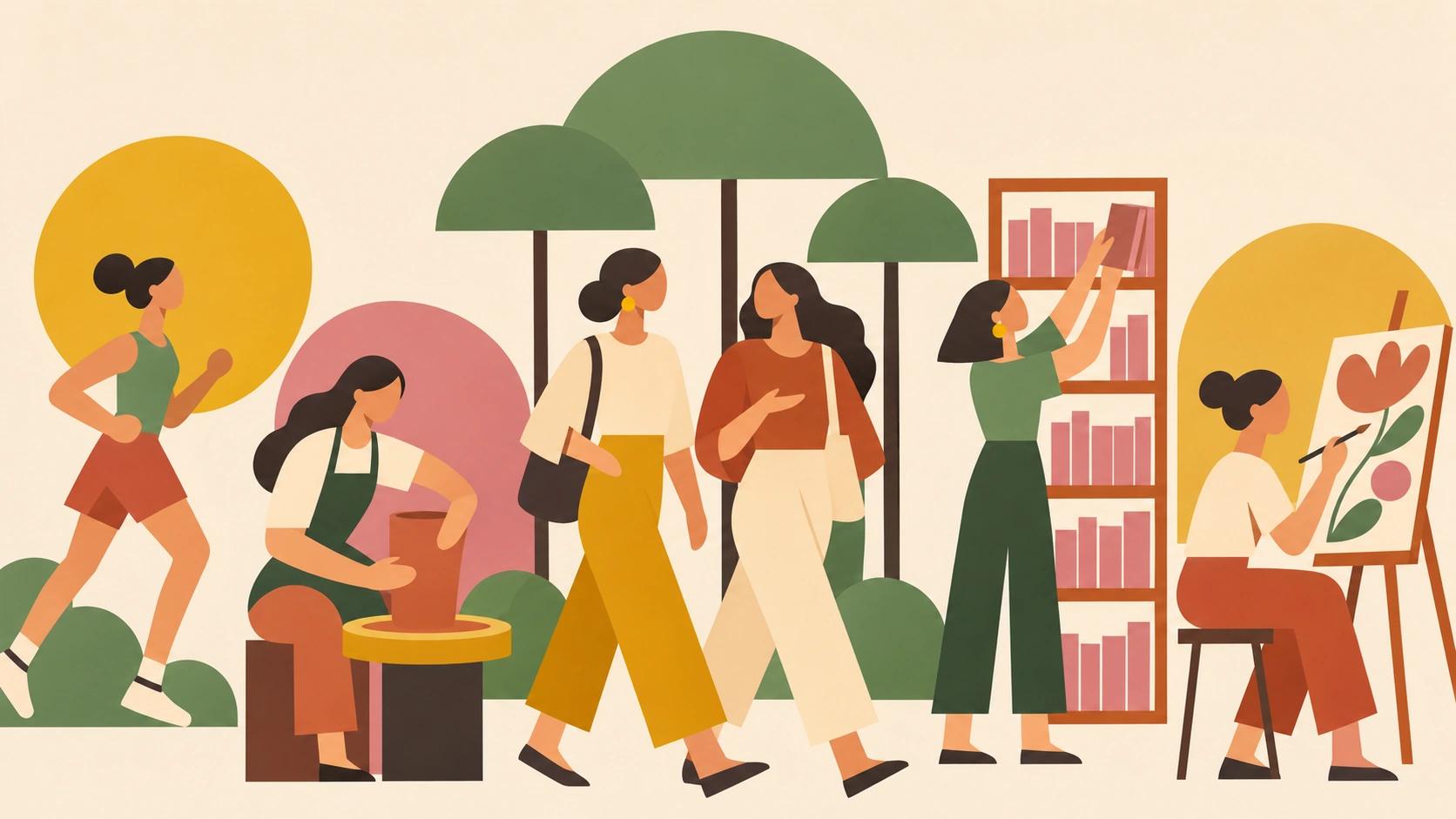
The generic "hobbies for women in their 40s" lists share a tell. They treat energy as the filter the decade applies to leisure, and they respond with softer versions of what they already recommended in the thirties, like gentler yoga, calmer gardening, and slower dance. Scheduling cost is what the decade actually filters for, specifically whose schedule the hobby has to interrupt.
The forties are the decade most likely to come with caregiving on two sides. A 2026 Pew Research Center analysis found that 54% of Americans in their 40s have a parent aged 65 or older and are also raising a child or supporting an adult one, more than any other age group. Women also still do more of the unpaid work at home; the U.S. Bureau of Labor Statistics' American Time Use Survey has measured that gap every year since 2003. The practical result for hobbies: many women in their forties have fewer uninterrupted blocks of time, more pre-committed Saturdays, and a sharper opportunity cost for anything that requires driving somewhere specific at a specific hour.
This is why the lists keep failing. They optimize for interest, offering fun hobbies for women in their 40s and an endless parade of unique-angle variations, when the real selector is structural reachability. The categories that survive the decade are the ones that cost the least to start and the least to resume after a two-week gap when something at home ate the schedule.
What the generic lists miss about forty, specifically for women
Hobby content aimed at women tends to treat the forties as a transitional stage between the thirties and the fifties, inheriting problems from both. That reading loses the shape of the actual decade. Children in a 44-year-old's household are more autonomous than in a 34-year-old's, which gives back some evening time, but they are also more scheduled, which eats more weekend time. Parents who managed on their own ten years ago often need more help now. Careers compound rather than open. The forties bring seniority, which brings calendars that spill into everyone else's.
What the lists call "hobby ideas for women in their 40s" are usually hobbies that work in a thirty-year-old's week: a pottery class across town on Wednesday evenings, a weekly book club at seven, a Saturday morning hiking group. These require protected and recurring blocks. For many women in their forties, those blocks are the first thing to go.
A better frame comes from the sociologist Robert Stebbins, whose serious leisure perspective separates casual leisure, the easy pleasures that need no training, from serious leisure: amateur pursuits people keep up for years and get genuinely good at. The forties reward hobbies that can start casually, tolerate interruption, and still deepen over time. Hobbies for women in their 30s or hobbies for women in their 50s can often tolerate pursuits that demand a fixed weekly cadence, because the caregiving load on either side of forty tends to be lighter. For the forties, the structural question is which activity still delivers meaning when the week fractures.
The two categories that absorb a hard week: structured movement and generative craft
Two families reliably survive. The first is structured movement that can be done solo and at variable times: swimming, running, strength training at home, yoga on a mat in the living room, cycling that does not require a group. The structure comes from the body rather than from the schedule. A thirty-minute walk at 6 a.m. and a thirty-minute walk at 10 p.m. do similar work. The friction between impulse and first step is low, which matters more at forty than at thirty.
The second is what might be called generative craft: knitting, sewing, baking bread, drawing, pottery done at home rather than in a studio, hand-lettering, needlework, woodworking of the small-project variety. These share three traits that matter in a crowded decade. They can be paused mid-stitch and picked up a week later. They produce a small object at the end of each session, which gives the brain a modest hit of what motivation researchers call competence, one of the three needs identified in self-determination theory. And they coexist with other activity, as a sweater can be knit while a child does homework at the same table.
Notice what both categories share. The hobby lives in the house. The hobby does not require coordinating with other adults' calendars. The hobby accepts a seven-minute session as readily as a seventy-minute one. That is the structural shape the forties can hold.
The reciprocal-social anchor the forty-for-women lists underweight
The lists push social hobbies, with book clubs, dance classes, and group hiking leading the field, and underweight how much of adult social time by forty has shifted onto reciprocal invitations rather than open calendars. A standing weekly commitment to eight other women competes with the children's weekend tournament and the parent who needs a hospital visit. The commitment unravels, and the hobby takes the blame when the problem was the format.
What tends to survive is one deeper reciprocal thread: a monthly dinner with two friends, a running partner once a fortnight, a shared garden plot with a neighbor. The group becomes small enough that cancellations are tolerated and warm enough that reconnection is low-friction. The sociologist Robert Putnam's long study of American social life, Bowling Alone, documents the decline of clubs, leagues and other group activities in the United States since the 1950s. For many women in their forties, what replaces the group is smaller: one or two people, repeated, flexible. That is a social hobby. It just does not look like the ones on the lists.
The quieter two: knowledge depth and one creative medium
Two further categories do important work for new hobbies for women in midlife, and for hobbies for women over 40 more broadly.
Knowledge depth means going unreasonably deep on a specific subject: a region's history, a composer's catalogue, a particular bird family, mid-century modern furniture, the Napoleonic Wars, mushrooms. The activity is reading, listening, and occasionally visiting. Scheduling cost is near zero. The payoff accumulates over years. For a woman whose job keeps her analytically engaged all week, this may not appeal; for one whose work is operational or caregiving-heavy, the chance to be an amateur expert in something no one is paying her to know is unusually restorative.
One creative medium means picking a single discipline, perhaps writing, photography, drawing, or piano, and keeping only that one. The temptation at forty is to sample broadly, which is a thirty-something's move. Depth in one medium pays compounding returns the way breadth usually does not. The medium becomes a lens the rest of life gets filtered through: one absorbing thread that shapes how ordinary days feel, rather than a busy slate of activities.
Three shapes the lists push that quietly stop within a few months
Three categories dominate the "fun hobbies for women in their 40s" lists and reliably stall. Each has the same failure mode. It runs on enthusiasm at first and fades when the schedule tightens.
Studio classes with weekly commitments, including pottery, dance, and specific-time yoga at a specific studio. The format is unforgiving. Miss two in a row and the thread snaps.
Hobbies with large setup costs, like the expensive camera, the sewing machine upgrade, or the full set of watercolor supplies. The financial outlay feels like commitment, but real commitment lives in the ten-minute session on a Tuesday that happens even when the day was difficult.
Hobbies styled explicitly as "unique hobbies for women in their 40s," such as goat yoga, aerial silks, or sword-fighting classes. These make good content for women's magazine lists because they are novel. The quality that sustains an adult hobby is repeated low-friction access to something genuinely liked. Novelty wears off. For a longer treatment of what makes any hobby stick, our main piece on hobbies for adults covers the research on autotelic activity and the overjustification effect. The additions for women in their forties are structural rather than motivational. The decade's filter is scheduling cost, and the hobbies that pass through it are the ones that cost the least to begin and the least to resume.
References
- U.S. Bureau of Labor Statistics. American Time Use Survey. Ongoing annual survey. American Time Use Survey
- Pew Research Center (2026). 54% of Americans in their 40s have both an aging parent and own child. Survey of U.S. adults, September 2025.
- Stebbins, Robert A. The serious leisure perspective, 1982 onward. serious leisure perspective
- Deci, Edward L., and Richard M. Ryan. Self-Determination Theory. Ongoing research program, 1971 onward. self-determination theory
- Putnam, Robert D. Bowling Alone: The Collapse and Revival of American Community. Simon & Schuster, 2000. Bowling Alone