Hobbies to Do Alone at Home: A Cleaner Way to Sort the Options
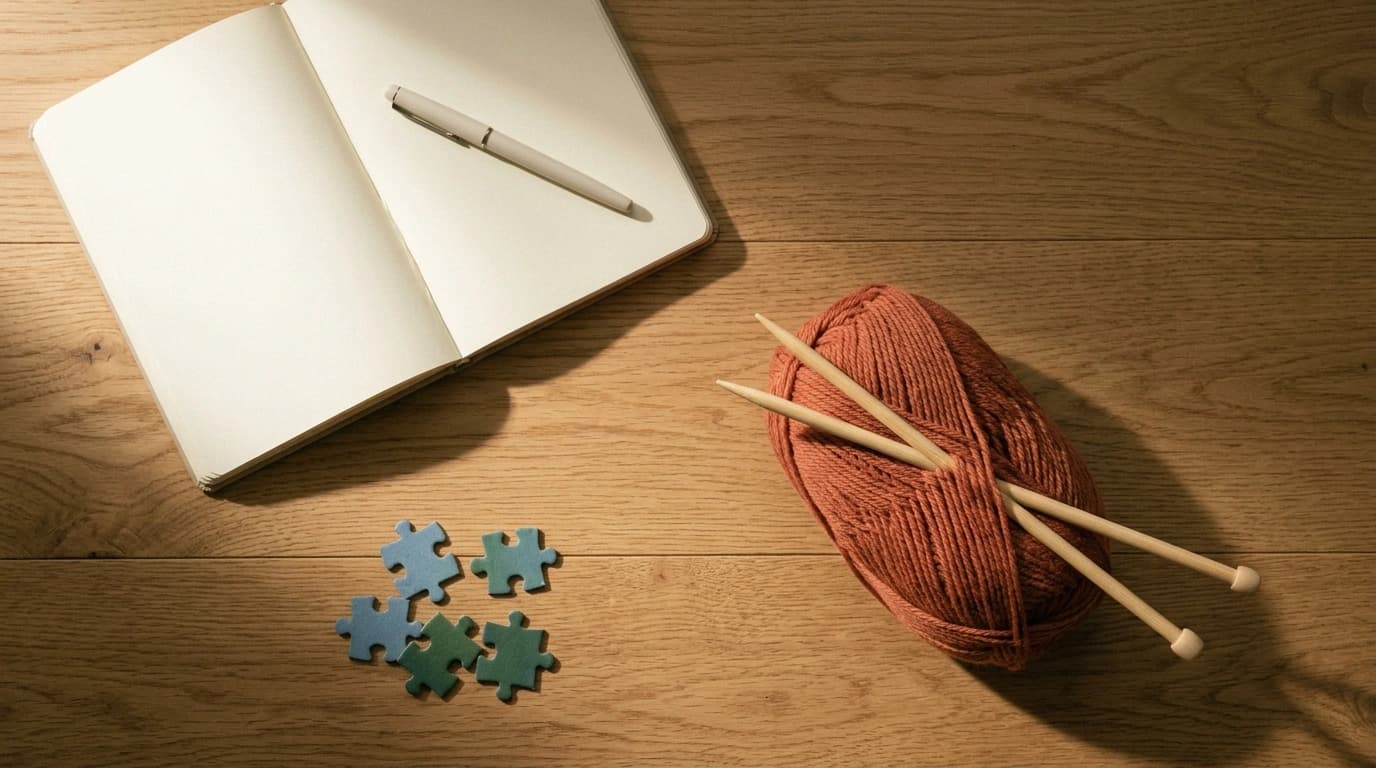
Most articles titled "best hobbies to do alone at home" sort the wrong way. They line up activities (reading, painting, chess, jigsaw puzzles, calligraphy) as if the choice were about taste alone. Taste matters. What matters more, at the end of a working day inside your own four walls, is what you need the hour to do for you. The same activity that restores one person leaves another slightly more tired. The category mistake is putting the object before the function.
Sort by what you're depleted on, not what sounds interesting
The useful pre-hobby question is diagnostic: what did the day take from you? Speech, decisions, screen focus, and physical stillness are the usual answers. The one that applies usually suggests the shape of the activity that will restore you. A day of hard analytical work rarely wants more analytical thinking after dinner, no matter how appealing chess sounds in the abstract. A day of relentless small talk sends a person toward silence and their hands.
This is why most "creative hobbies to do at home alone" listicles fail their reader. They sort by object rather than by function. The same jigsaw puzzle is a low-cost sedative for the depleted analyst and a boring chore for the person who spent the day organizing a spreadsheet by hand. The choice depends less on the puzzle than on the day it lands in.
A shorter diagnostic runs through three questions. What have you had too much of today? What have you had too little of? And what is your energy budget, honestly measured, for the next ninety minutes? The answers narrow the field before any list of activities enters the picture.
The low-effort replenishers: hobbies that ask almost nothing back
The first useful category is what might be called low-effort replenishers: activities that require almost no decision-making, no external goal, and a low cognitive load, and that return something to a nervous system that has been on all day. These are the quiet hobbies to do at home when the day has already spent your executive function.
A jigsaw puzzle qualifies. So does knitting a scarf you already know how to knit, tending houseplants, watering a windowsill herb garden, sketching a familiar object without judgment, folding origami, listening to a full album with the lights low, or working slowly through a crossword. Reading fiction belongs here too, provided the book is genuinely enjoyable rather than one you feel you should be reading. The common thread is a low ratio of decisions per minute.
Cheap hobbies to do at home alone tend to cluster in this replenisher category by no accident. A puzzle, a set of colored pencils, a library card, a deck of cards for solitaire: none of these require outlay beyond a few dollars. The stylistic and the financial travel together. Replenishing activities work precisely because their demands are small; the material demands often are too.
There is a plain name for this kind of steady, non-performative doing: hand work. The category covers the everyday folding, stirring, trimming, and sorting that quietly holds a day together, rather than the elevated craft featured in coffee-table books. It is old and unglamorous. It is also, reliably, restorative.
The skill-builders and the makers: two shapes that give more when you have more
The second and third useful categories require more from the person picking them up, and pay back proportionally.
Skill-builders are the pursuits with a slow-climbing learning curve: a musical instrument, a new language via app or textbook, chess study, drawing from life, cooking cuisines you did not grow up with, working through a photography curriculum on your own. These are the answer when the day left cognitive energy on the table and the itch is for progress, for the feeling of a competent version of yourself getting built out over months. They will punish a depleted brain. Attempted on a good day, they deliver what psychologists studying flow describe as challenge matched to skill in a way that erases the clock.
Makers overlap with skill-builders but occupy a distinct shape. Baking bread, small-batch woodworking, sewing, model-building, homebrewing, writing a chapter, coding a small tool no one asked for. The output is the point. So is the small pride of pointing at a physical thing on Sunday and saying, this was not here on Friday. Makers require a workspace (even a corner counts) and enough patience for the mess of a project mid-way through. They are the deepest category, and the least suited to a truly wiped evening.
Both categories reward the same three-need calculus behind self-determination theory (autonomy, competence, and relatedness) in solo form. The person chooses the pursuit. Competence accumulates visibly. Even alone at home, the wider community of amateurs (bakers, guitarists, hobby coders) supplies the third need through forums, video comments, and small messages between strangers.
Alone at home isn't the same as isolated at home
There is a category error worth naming. Doing a hobby alone at home is a chosen state. Being isolated at home is the involuntary version, the one linked in the loneliness literature to health outcomes worth taking seriously. The two arrive by different routes and produce different consequences, even when the surface picture looks similar.
A hobby practiced solo can still serve connection in several ways at once. Home bakers post pictures of the crumb structure and get feedback from a subreddit half a world away. Language learners join weekly online conversation practice from the same desk chair. Amateur astronomers photograph the same eclipse as fifty thousand strangers and compare notes the next morning. The activity happens in one room; the community around it does not.
This is where "solo hobbies at home" tips into something socially rich rather than socially thin. Nobody needs to leave the house for it to happen. The corner of the internet where other people who care about the same tiny thing exist is trivial to find for almost any pursuit.
The version that does start to look isolating is the one that requires zero contact of any kind for weeks on end and produces nothing anyone else will ever see. That version is worth catching before it becomes the default. A one-line message per week to a fellow hobbyist is usually the cheapest fix.
The one you'll actually reopen tomorrow
The final and most useful test is behavioral rather than aspirational. The right hobby, out of the ones under consideration, is the one that gets reopened the next day without prompting. Self-image and impression have almost no predictive power here. What predicts is whether the object earns a second sitting on an ordinary evening.
This test matters because adults are prone to picking hobbies for who they want to be seen as rather than for what actually restores them. A person may buy a beautiful chess set, read a beginner's guide, play twice, and never touch it again. Meanwhile, a jigsaw puzzle bought half-heartedly ends up on the dining table for three weeks. The self-image chose the chess. The evening chose the puzzle.
The relaxing hobbies to do at home that stick are almost always the ones with the shortest gap between impulse and first move. Instruments left out of their case. Sketchbooks on the coffee table. A puzzle already partly assembled. Friction beats good intentions almost every time.
For anyone still stuck, the broader question of what a hobby actually is for adults sits one layer up, along with why working life so often erodes them. The practical version is small and boring. Pick two candidates from different categories: one replenisher and one skill-builder. Set them out where they are visible. Give each a fair week of chances. Watch which one gets reached for on the ordinary Tuesday when nobody is asking anything of anyone. That is the answer. The one that quietly earns a second sitting, without ceremony, is the one that fits the life already in place.
References
- Csikszentmihalyi, Mihaly. Flow: The Psychology of Optimal Experience. Harper & Row, 1990. flow
- Deci, Edward L., and Richard M. Ryan. Self-Determination Theory. Ongoing research program, 1971 onward. self-determination theory