Productive Hobbies for Adults: The Hidden Split Inside the Search
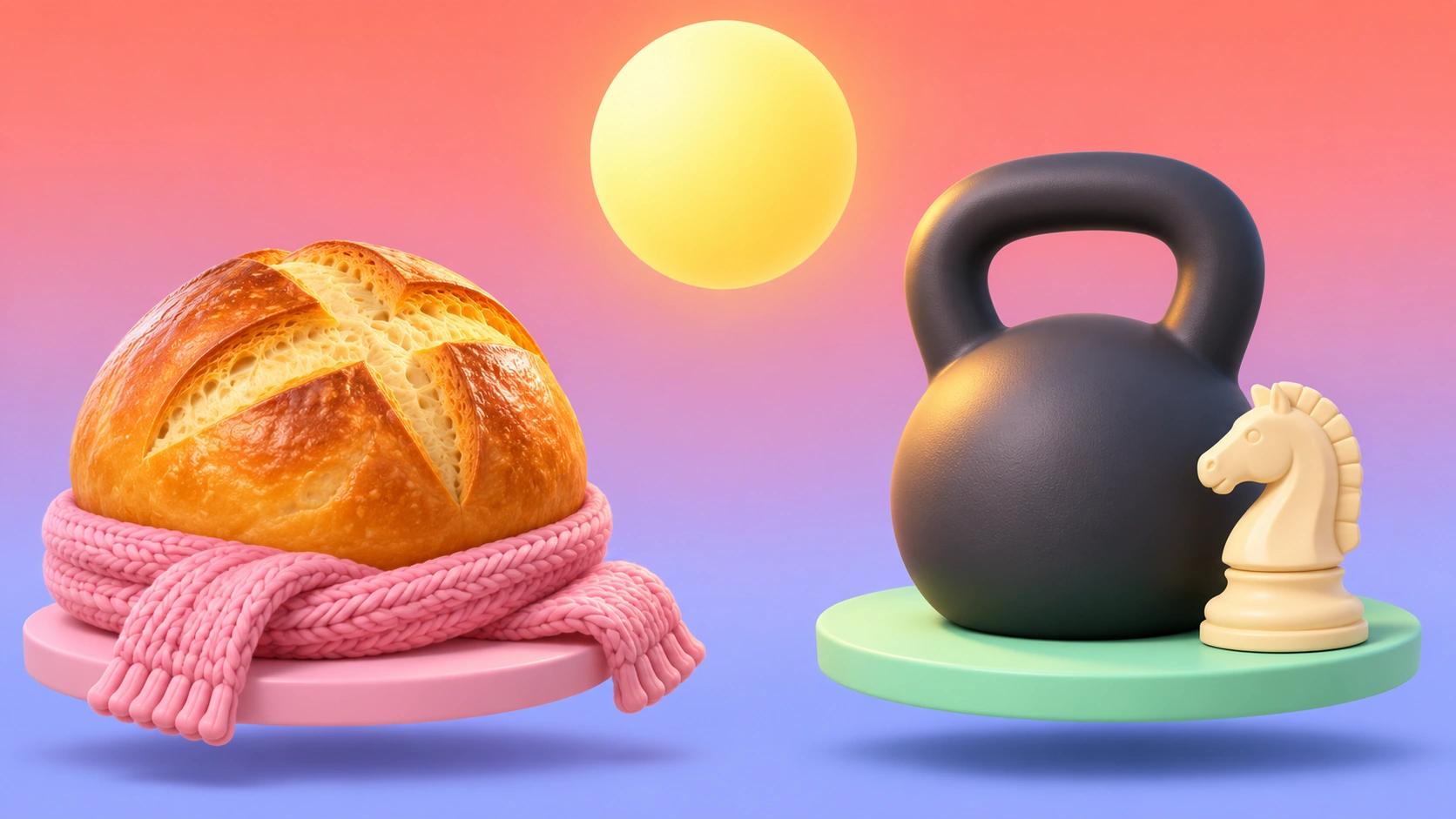
The phrase "productive hobbies for adults" sounds like it names one thing. It names two, and they fit different lives. The reader who types it into a search bar is usually asking one of two very different questions, and the lists that come back answer both at once, which is why so many adults start a productive hobby and quit a few weeks later. The split is worth naming before anyone picks.
The hidden category mistake inside "productive hobby"
Underneath the search are two separate wishes.
One wish is for an afternoon that leaves a thing. A loaf. A sweater. A row of beans. The hobby's output is tangible, and the pleasure is partly the output itself.
The other wish is for a hobby that is slowly building something inside the practitioner. A year of twenty-minute Spanish evenings. A slow climb up the chess ladder. A bench press that moves fifty pounds in a year. The output here is the person doing it; the hour has grown a capacity rather than an object.
Both qualify as hobbies that are productive. They just produce different things. Confusing the two is how a baking-crazed knowledge worker buys a sourdough starter and resents it by week four, or how a stay-at-home parent of young children signs up for Mandarin lessons and finds themselves hollowed out by the thought of one more effortful commitment. Each picked the wrong kind of productive. The main piece on hobbies for adults argues that a hobby's whole point is to be done for its own sake, and that "productive" imports a scorecard most hobbies were never meant to carry. Within the productive-hobby category, the task is to pick the sort of scorecard your week can carry.
Hobbies that produce a thing you can hold
The first category is output-first. At the end of a session, something exists that did not exist before.
A short list of productive hobbies in this family: baking and bread-making, knitting, sewing and mending, woodworking, pottery, container and raised-bed gardening, furniture restoration, candle and soap making, canning and preserving, model building, journaling with a bound notebook, and letter writing by hand.
Output-first hobbies tend to fill the typical lists of most productive hobbies, because the output photographs well. More usefully, they close a loop. For people whose paid work is open-ended knowledge tasks, the kind without a clear done, a finished loaf of bread at nine on a Sunday night can settle something a yoga class does not. The restorative part is the finished thing itself.
They are also the most natural productive hobbies at home. Setup costs are low, equipment is modest, and almost all of them scale down to a windowsill, a corner of a kitchen counter, or a single evening a week.
Hobbies that quietly build a capacity you'll use later
The second category is capacity-first. At the end of a session, there is no object. Something has compounded inside the person doing it.
A short list of hobbies that improve your life this way: a second language, a musical instrument, strength training, learning to cook a cuisine you did not grow up with, chess, bridge or go, drawing from life, formal reading programs, amateur photography with the technical side taken seriously, and typing practice if the typing is bad. Each one builds a skill the practitioner carries into every subsequent year.
The real promise of capacity-first hobbies is that the practitioner is a different person at the end of them. The language learner can read a novel in Spanish. The weight lifter can carry both grocery bags up three flights of stairs without stopping. The guitarist can play a song at a party when asked. These are small, specific competencies, and they stack.
Hobbies that make you better in this sense have one unforgiving feature: they feel unproductive for the first few months. There is no sweater. There is a Duolingo tree, a wobbly scale on a guitar, a chess rating that drifts around 800. Adults used to measurable progress at work mistake the shape of the curve for a flat line and quit. The right expectation here is that the first year of a capacity-first hobby is largely invisible. Progress happens; it just happens where no one can see it.
How to pick between the two: overworked picks differently than understimulated
The decision is less about which hobby and more about which week it is landing in.
Weeks heavy on open-ended knowledge work, caregiving for young children, or care of ageing parents already have too many undone things in them. A finished thing — a loaf, a jar, a mended coat — is restorative in those weeks. Output-first fits. Baking, mending, or a tended tomato plant closes a visible loop in a life full of invisible ones.
Weeks heavy on repetition, such as a routine job without stretch, a long caregiving plateau, or the quieter years of early retirement, have the opposite shape. Nothing is open. Days feel flat. Capacity-first fits here, because the slow build is the whole point. The Spanish, the piano, the strength program each add a measurable gradient to a week that otherwise has none.
Two smaller cuts help. First: indoor or outdoor. Someone who sits all day needs a hobby that stands them up; someone on their feet all day needs one that sits them down. The best indoor hobbies for adults with sedentary jobs are the active ones, like pottery, social dance, or martial arts, and the best outdoor ones for anyone on their feet are the quiet observational ones, like birding or stargazing. Second: setup cost. A productive hobby that requires a dedicated room, a nine-hundred-dollar machine, and a forty-minute drive loses to the couch every time. Start cheap. Upgrade later if the thing survives.
The trap the search itself is a symptom of
The phrase "productive hobbies for adults" is already a diagnostic. Nobody searches for productive friendships, productive naps, or productive walks. The word slips in only when the searcher has absorbed, somewhere between graduation and middle age, the suspicion that unmetered hours are wasted ones.
That is a cultural inheritance worth naming before picking a hobby in its shadow. The U.S. Bureau of Labor Statistics' American Time Use Survey finds that the largest single leisure category in American adult life is still watching television, by a wide margin. Television is unproductive by any measure. Plenty of those hours are still enjoyed. A Saturday in a garden chair is not a lesser Saturday than one spent knitting the hours into a scarf. The real question underneath the search is often how to spend an afternoon without feeling guilty, which is a different question from how to produce the most.
The second question has a different answer, and it is worth separating. The practical move is to treat the first productive-hobby season as rehearsal. A baker who has learned, in a kitchen on a Sunday, to be content with slow work has trained the muscle. The next hobby, maybe one with no visible output and no measurable compounding, lands on softer ground. The baker has already produced the thing that will carry into the afternoon with no bread.
References
- U.S. Bureau of Labor Statistics. American Time Use Survey. American Time Use Survey